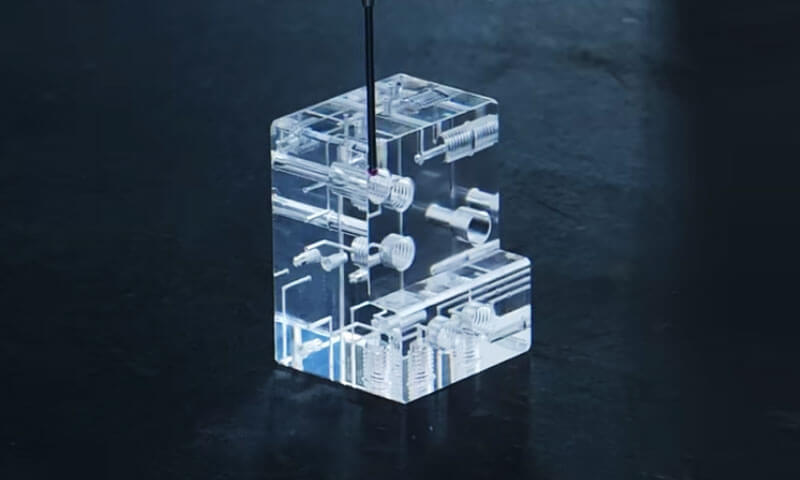
الأكريليك, or polymethyl methacrylate (PMMA), is one of the most versatile engineering plastics in modern manufacturing.
It is transparent, متينة, and dimensionally stable—three properties that rarely coexist in a single material.
From medical device housings and laboratory equipment to automotive light lenses, point-of-purchase displays, and precision fluidic components, acrylic parts perform functions that glass, البولي, and other polymers cannot match on their own.
But acrylic is not a single material. It exists in cast and extruded forms with significantly different properties, and it can be shaped by CNC machining, صب الحقن, قطع الليزر, تشكيل حراري, and bonding.
Choosing the right material form and the right manufacturing process is the difference between a part that performs flawlessly and one that cracks, crazes, or fails dimensional inspection.
This article examines precision custom acrylic parts from the perspective of a specialized manufacturer.
1. What Is Acrylic (PMMA)?
Polymethyl methacrylate (PMMA) is a transparent, amorphous thermoplastic polymer produced by the polymerization of methyl methacrylate (MMA) monomer.
It was first commercialized in the 1930ق and has since become one of the world’s most widely used transparent plastics.
PMMA is commonly known simply as “acrylic”, but the material is also marketed under well-known trade names such as Plexiglas, Perspex, Lucite, Acrylite, and Altuglas.
These trade names refer to commercial products or brands based on acrylic materials; the underlying polymer is PMMA.
The appeal of PMMA lies in its combination of high optical transparency, كثافة منخفضة, good surface hardness, مقاومة الأشعة فوق البنفسجية, قابلية الطقس, وسهولة التصنيع.
High-quality clear PMMA can provide visible-light transmission of approximately 90–92%, giving it a glass-like appearance while weighing only about half as much as conventional glass by volume.
2. What Are the Different Types of Acrylics (PMMA)?
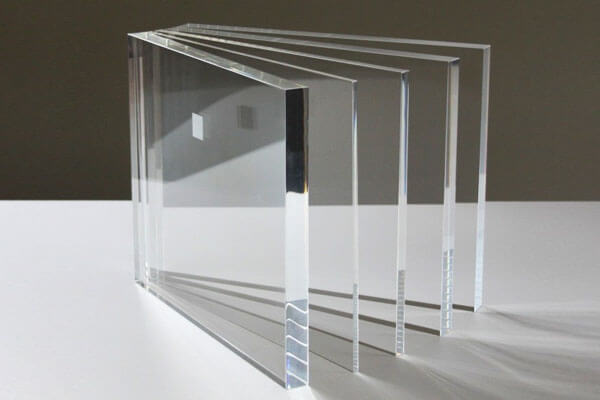
For precision acrylic parts, PMMA stock is commonly divided into cast PMMA and extruded PMMA according to how the material is manufactured.
Although both are based on the same polymer, their processing history can produce differences in molecular weight, الإجهاد المتبقي, السلوك الحراري, optical quality, and machining performance.
Cast PMMA
Cast PMMA is produced by polymerizing liquid methyl methacrylate (MMA) between molds, commonly glass plates for sheet production.
Compared with extruded material, cast PMMA generally offers higher molecular weight, lower residual stress, الاستقرار الحراري الجيد, and excellent optical clarity.
These characteristics make cast PMMA particularly suitable for تصنيع CNC.
Under properly controlled cutting conditions, it can produce relatively clean chips and well-defined machined edges, while reducing the tendency toward excessive softening or smearing at the cutting zone.
Cast PMMA is therefore commonly selected for precision components such as optical covers, transparent housings, inspection windows, النماذج الأولية, and custom-machined acrylic parts.
Extruded PMMA
Extruded PMMA is manufactured by continuously melting acrylic resin pellets and forcing the polymer through a die.
The extrusion process provides efficient production of standardized sheets, قضبان, الأنابيب, والملامح, but it can introduce molecular orientation and higher residual internal stress.
During aggressive CNC machining, these characteristics can increase the risk of heat-related deformation, edge melting, and stress crazing, particularly when cutting conditions are poorly controlled or the component contains sharp internal features.
Extruded PMMA remains widely useful for general fabricated acrylic products and standardized stock, but for demanding subtractive machining, cast PMMA is often preferred when dimensional stability, جودة السطح, and low machining stress are critical.
3. Core Material Properties of Acrylic (PMMA) for Precision Components
Understanding the material properties of PMMA is essential for designing parts that perform reliably. The following properties are particularly relevant for precision components.
Optical properties.
PMMA transmits approximately 92% من الضوء المرئي, compared with about 90% for glass.
It has a refractive index of 1.49 and low dispersion, making it suitable for lenses, light guides, and optical windows. It does not yellow significantly under UV exposure, unlike many other plastics.
الخصائص الميكانيكية.
PMMA is rigid and hard. Typical tensile strength is 65–75 MPa, flexural strength is 90–110 MPa, and tensile modulus is 2.4–3.2 GPa.
It is brittle compared with polycarbonate, with notched Izod impact strength of 15–25 J/m.
This means acrylic parts must be designed to avoid stress concentrations that could initiate cracks.
الخصائص الحرارية.
The glass transition temperature of PMMA is approximately 105°C, and the heat deflection temperature is around 95°C at 0.45 MPA.
Service temperature is typically limited to 80°C for continuous use. Thermal expansion coefficient is approximately 70 × 10⁻⁶ /درجة مئوية, which is higher than most metals but lower than many other plastics.
المقاومة الكيميائية.
PMMA resists dilute acids, القلويات, الهيدروكربونات الأليفاتية, and mineral oils.
It is attacked by ketones (acetone, MEK), esters, chlorinated hydrocarbons, and aromatic hydrocarbons.
Alcohols can cause stress cracking in stressed parts. This must be considered when selecting cleaning agents and adhesives.
امتصاص الرطوبة.
PMMA absorbs approximately 0.3–0.4% water at saturation. This is low compared with nylon or polycarbonate, but it can still cause dimensional changes in precision parts.
للتطبيقات الحرجة, parts should be conditioned before final machining.
الخصائص الكهربائية.
PMMA has good dielectric strength (تقريبًا 20 كيلو فولت / مم) and volume resistivity (approximately 10¹⁵ Ω·cm), making it suitable for electrical and electronic applications.
Weather resistance.
PMMA is highly resistant to UV radiation and outdoor weathering. It is widely used in outdoor signage, تقليم السيارات, and architectural glazing.
لكن, prolonged exposure to UV can cause surface degradation in some formulations, so UV-stabilized grades are recommended for outdoor use.
التوافق الحيوي.
Medical-grade PMMA is available and is used in dental prosthetics, bone cement, and medical device components.
It can be sterilized by ethylene oxide, gamma radiation, or autoclaving (with limitations).
4. Precision CNC Machining of Acrylic (PMMA) أجزاء
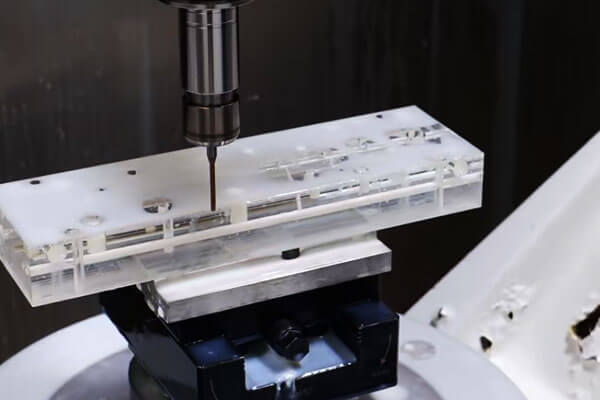
تصنيع CNC is one of the most flexible methods for producing precision custom acrylic (PMMA) أجزاء, particularly when the required quantity is relatively small, the geometry is highly customized, or the design must be changed frequently.
Unlike injection molding, CNC machining does not require a dedicated production mold.
The finished component is produced directly from PMMA sheet, طبق, عصا, حاجز, or other suitable stock by removing material with computer-controlled cutting tools.
Common CNC operations for PMMA include الطحن, تحول, حفر, ممل, توسيع, التوجيه, chamfering, and engraving.
Depending on the geometry and required optical quality, machining can be followed by polishing or other surface-finishing operations.
The main challenge is thermal management. PMMA has relatively low thermal conductivity, so heat generated at the cutting zone can accumulate rapidly.
Excessive heat may soften the polymer and cause melting, burr formation, surface smearing, dimensional distortion, or stress crazing.
Sharp tooling, appropriate cutting parameters, efficient chip evacuation, and rigid but low-stress fixturing are therefore essential.
CNC Machining Process for PMMA
A typical precision workflow is:
Material Selection → CAD/CAM Programming → Workholding → Rough Machining → Finish Machining → Deburring → Polishing/Surface Finishing → Dimensional Inspection
The material should be selected according to the application and machining requirements.
Cast PMMA is often preferred for demanding subtractive machining because its material characteristics can provide favorable dimensional and machining behavior,
while extruded stock can also be successfully machined when residual stress and thermal effects are properly controlled.
During CAM programming, the tool path should avoid unnecessary heat accumulation.
High tool engagement, prolonged rubbing, and repeated passes over the same area can generate excessive temperature even when the nominal cutting parameters appear reasonable.
Advantages of CNC Machining PMMA
High Design Flexibility
CNC machining can produce highly customized geometries without requiring injection-molding tooling.
Design modifications can normally be implemented through CAD/CAM changes rather than by manufacturing a new mold.
This makes the process especially suitable for engineering prototypes, functional samples, مكونات الاستبدال, and customized low-volume parts.
Excellent Feature Accessibility
CNC machining can directly produce precision features such as:
- Holes and bores
- Slots and pockets
- Threads where appropriate
- تصاعد الأسطح
- عدادات
- Chamfers
- Engraved markings
Complex combinations of features can be machined in a single setup when the machine and workholding arrangement permit.
Suitable for Prototypes and Low Volumes
CNC machining is economically attractive when the production quantity does not justify injection-molding tooling.
It also allows the manufacturer to move relatively quickly from a finished CAD design to a physical component.
High Dimensional Control
Modern CNC equipment can provide tight dimensional control when the PMMA stock, آلة, الأدوات, درجة حرارة, and measurement conditions are properly managed.
Critical features can also be inspected using CMMs, أنظمة الرؤية, or precision gauges.
Limitations of CNC Machining PMMA
The principal limitation is material removal efficiency. A significant portion of the original stock may become machining waste, particularly when the finished component has a small material-to-volume ratio.
CNC machining can also become expensive for large production quantities because cycle time and machine occupancy scale with the number of parts.
Other limitations include:
- Heat accumulation during cutting
- Risk of burrs or edge melting
- Potential release of residual stress
- Higher unit cost at high volumes
- Need for additional polishing for optical surfaces
- Increased handling requirements for scratch-sensitive transparent parts
لهذه الأسباب, CNC machining is generally strongest at the prototype and low-volume end of the production spectrum.
5. Injection Molding of Custom Acrylic (PMMA) أجزاء
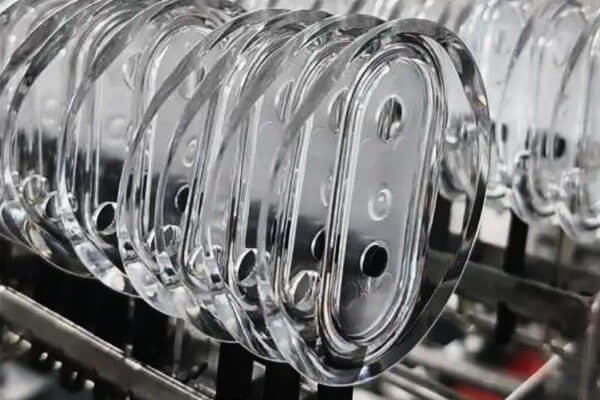
صب الحقن forms PMMA parts by heating the thermoplastic above its processing range, injecting the molten polymer into a precision mold under pressure, allowing the material to cool and solidify, and then ejecting the finished component.
على عكس التصنيع باستخدام الحاسب الآلي, which removes material from a solid blank, injection molding creates the required geometry directly through the mold cavity.
This makes it particularly effective for repeat production of complex shapes and high-volume components.
A typical PMMA injection-molding cycle is:
Resin Drying → Plasticizing → Injection → Packing/Holding → Cooling → Ejection → Inspection
PMMA requires appropriate moisture control before processing. Excessive moisture in the resin can contribute to bubbles, silver streaks, haze, and other surface or optical defects.
Drying conditions should follow the resin manufacturer’s specification.
Optical-Quality Injection Molding
When the PMMA part is intended for optical or transparent applications, dimensional accuracy alone is insufficient.
The process must also control:
Flow behavior + cooling uniformity + الإجهاد المتبقي + mold surface condition
Poorly controlled filling or cooling can create optical distortion even when the part dimensions remain within tolerance.
The mold surface itself acts as a direct replica surface. Any defect, تلوث, يخدش, or inappropriate texture on a critical mold surface can be transferred to the finished acrylic part.
لهذا السبب, optical PMMA molding often requires particularly careful control of mold polishing, resin drying, filling conditions, تنفيس, and cooling.
Advantages of Injection Molding PMMA
المزايا:
- Low per-unit cost at volume: Once tooling is amortized, unit cost is low.
- High production rate: Thousands of parts per day are possible.
- التكرار ممتازة: Consistent dimensions and properties.
- الهندسة المعقدة: ميزات متكاملة, أضلاع, الرؤساء, and snap fits can be molded.
- الانتهاء من السطح: Mold texture is replicated on the part.
- Material variety: Colored, مملوء, and specialty grades are available.
- الأتمتة: The process can be fully automated.
القيود:
- تكلفة أدوات عالية: Molds can cost tens of thousands of dollars.
- Long lead time: Mold fabrication takes weeks to months.
- قيود التصميم: زوايا مسودة, wall thickness uniformity, and gate location must be considered.
- Material limitations: Very high molecular weight cast acrylic cannot be molded.
- الإجهاد المتبقي: Molded parts may have residual stress and birefringence.
- Minimum volume: Not economical for low volumes.
6. Technical & Economic Comparison: CNC Machining vs. صب الحقن
CNC machining and injection molding can both produce precision custom PMMA parts, but they are optimized for different production conditions.
The main distinction is that CNC machining removes material from solid PMMA stock, while injection molding forms the part directly in a mold.
نتيجة ل, their cost structure, مرونة التصميم, كفاءة الإنتاج, and material utilization are quite different.
| Key Factor | تصنيع CNC | صب الحقن |
| مبدأ التصنيع | Subtractive machining from PMMA sheet, طبق, عصا, or block | Forming molten PMMA inside a precision mold |
| Best Production Volume | النموذج الأولي, عينة, والإنتاج المنخفض الحجم | واسطة- وإنتاج الحجم العالي |
| تكلفة الأدوات الأولية | قليل; mainly standard cutting tools and fixtures | عالي; dedicated mold required |
| تكلفة الوحدة | Relatively high because machining time increases with quantity | Relatively low after mold investment is amortized |
| مرونة التصميم | ممتاز; CAD changes can usually be implemented without new tooling | Limited after tooling; major design changes may require mold modification |
| Development Speed | سريع; suitable for rapid prototypes | Slower because mold design, تصنيع, and trials are required |
Complex 3D Geometry |
جيد, but constrained by tool access and machining strategy | ممتاز for molded ribs, الرؤساء, مقاطع, ومميزات متكاملة |
| دقة الأبعاد | High and directly controlled by CNC tool paths | High after process stabilization, but affected by shrinkage and molding conditions |
| Optical Surface Quality | Excellent potential with controlled machining and polishing | Excellent potential with high-quality mold surfaces and stable molding |
| استخدام المواد | أدنى; removed material becomes machining waste | أعلى; part is formed near net shape, although runners and sprues create some waste |
| Wall Thickness Flexibility | Excellent for variable-thickness machined components | Requires careful control to minimize sink marks, parpage, والإجهاد المتبقي |
| الميزات الداخلية | Excellent for accessible holes, فتحات, and pockets | Excellent for molded bosses, أضلاع, and complex integrated features |
| التشطيب السطح | Easy to combine with polishing, طحن, or other secondary operations | Mold surface largely determines the as-molded finish; secondary finishing may still be required |
الإجهاد المتبقي |
Can be introduced or released during machining, especially in stressed stock | Molding can introduce residual orientation and thermal stress |
| Material Waste Cost | More significant for heavily machined geometries | Generally lower for high-volume near-net-shape parts |
| Part-to-Part Repeatability | Very high with stable CNC programming and process control | Very high after mold and molding parameters are stabilized |
| Economic Break-Even | Usually favorable at lower quantities | Becomes increasingly economical as production volume rises |
| Typical PMMA Applications | النماذج الأولية, optical parts, custom housings, مكونات الحجم المنخفض | أغطية, العلب, عروض, lighting components, high-volume custom parts |
| الميزة الرئيسية | Flexibility with low upfront investment | High productivity and low unit cost at scale |
| القيد الرئيسي | Higher unit cost and material removal | High tooling investment and lower design flexibility after tooling |
7. Acrylic Surface Finishing and Post-Processing
Surface finishing is critical for acrylic parts, especially when optical clarity or appearance is important. Common finishing operations include:
تلميع
Acrylic can be polished to a high optical finish using a sequence of abrasive papers, مركبات, and buffing wheels. Flame polishing and vapor polishing are also used for edge finishing.
الصلب
Machined or molded acrylic parts may be annealed to relieve internal stresses.
Annealing is typically performed at 70–80°C for several hours, تليها التبريد البطيء. This reduces the risk of crazing and cracking.
Vapor polishing
The part is exposed to solvent vapor, which smooths the surface. This produces a very high-gloss finish but requires careful control to avoid distortion.
Flame polishing
A controlled flame is passed over the surface, melting a thin layer and producing a smooth, الانتهاء اللامع. This is commonly used for edges.
Diamond Polishing
For demanding transparent components, diamond polishing can provide a highly refined surface. It is particularly useful where low surface roughness and high optical clarity are required.
Compared with conventional abrasive polishing, diamond-based processes can provide more controlled removal of very small amounts of material.
This makes them attractive for precision optical surfaces and components where visible machining marks must be minimized.
Painting and coating
Acrylic can be painted, screen printed, or coated with anti-reflective, anti-static, or hard-coat finishes.
Texturing and Matte Finishing
Not every PMMA part needs a transparent, سطح لامع. A controlled matte or textured finish can be used where glare reduction, visual appearance, light diffusion, or tactile characteristics are more important than maximum transparency.
Laser cutting and engraving
Laser processing is used for cutting, نقش, and marking acrylic. It produces a polished edge in some cases.
Bonding and assembly
Acrylic can be joined by solvent welding, الترابط اللاصق, ultrasonic welding, or mechanical fastening. Solvent welding produces a transparent joint but requires careful control.
تنظيف
Acrylic should be cleaned with mild soap and water or specialized plastic cleaners. Solvents such as acetone and alcohol should be avoided, as they can cause crazing.
8. Applications of Custom Acrylic (PMMA) أجزاء
The combination of optical transparency, بناء خفيف الوزن, weather resistance, العزل الكهربائي, and machinability makes PMMA suitable for a broad range of custom components.
Optical and Photonics Components
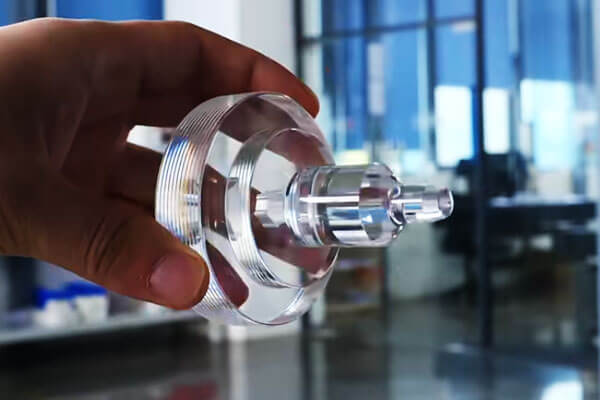
PMMA is widely used where controlled light transmission is required. Its optical clarity makes it suitable for components where visual transparency or light distribution is part of the function.
وتشمل التطبيقات النموذجية:
- Light guides
- Optical covers
- Transparent windows
- Display lenses
- Light-management components
- Protective optical housings
Electronics and Electrical Equipment
PMMA provides good electrical insulation and can create lightweight transparent protective structures.
Custom components may include:
- Transparent equipment covers
- Indicator windows
- Display housings
- Protective panels
- حاويات كهربائية
- Insulating spacers and fixtures
المعدات الصناعية
Industrial machinery often requires operators to observe internal processes without exposing moving or hazardous components.
PMMA can therefore be used for:
- Inspection windows
- حراس الآلة
- أغطية واقية
- Fluid-view components
- Transparent process housings
- Observation panels
Laboratory and Medical Equipment
PMMA’s transparency, clean appearance, and ease of fabrication make it useful for selected laboratory and medical equipment components.
يمكن أن تشمل التطبيقات:
- Instrument covers
- Fluid-view chambers
- Laboratory enclosures
- Sample inspection components
- مساكن المعدات
السيارات والنقل
PMMA can be used in selected السيارات and transportation applications where transparency, قابلية الطقس, and appearance are important.
ومن الأمثلة:
- Lighting-related components
- Indicator covers
- Display elements
- Interior transparent parts
- المكونات الزخرفية
Lighting and Display Products
This is one of PMMA’s strongest commercial application areas. The material can transmit light efficiently while allowing considerable design flexibility.
Custom PMMA components can be produced as:
- الناشرون
- Light guides
- Display panels
- Illuminated signs
- Decorative lighting components
- Transparent housings
Architectural and Commercial Products
PMMA is widely used for visual and decorative products because it can combine transparency with relatively low weight.
ومن الأمثلة:
- لافتات
- Display fixtures
- Retail structures
- لوحات زخرفية
- Architectural lighting elements
- Exhibition components
9. Cost Factors for Custom Acrylic Parts
مادة
Material selection has a direct impact on cost. Cast PMMA is generally more expensive than standard extruded PMMA,
while specialty grades such as UV-stabilized, anti-static, بصري, or medical-grade materials can carry additional costs.
Part thickness and stock dimensions are also important, particularly for CNC machining. A thick or oversized PMMA blank may increase both material consumption and machining waste.
تعقيد التصميم
Complex geometry increases manufacturing time and process requirements.
For CNC-machined parts, features such as deep pockets, تقف, الجدران الرقيقة, multiple setups, and complex 3D surfaces can increase machining hours and tooling requirements.
For injection molding, complicated geometry can increase mold design and manufacturing costs.
Undercuts may require slides or other mechanisms, while thin or uneven walls can require more sophisticated mold-flow and cooling design.
Tolerance Requirements
Tighter tolerances require greater process control and more inspection.
A general PMMA component may not need the same tolerance level as an optical or precision-fit component.
Over-specifying tolerances can therefore increase manufacturing cost without providing additional functional value.
For PMMA specifically, dimensional control may also be influenced by temperature, الإجهاد المتبقي, and material processing history, so critical tolerances should be defined according to actual functional requirements.
حجم الإنتاج
Production volume is one of the most important factors when choosing between CNC machining and injection molding.
Low-volume production generally favors CNC machining because the process requires relatively little dedicated tooling.
Higher-volume production generally favors injection molding, because the initial mold investment can be spread across many parts.
There is no universal break-even quantity. It depends on the part size, الهندسة, وقت المعالجة, mold cost, وقت الدورة, and annual production requirement.
الانتهاء من السطح
Surface finishing can significantly affect the cost of transparent acrylic parts.
Basic CNC finishing requires less processing than fine polishing, بينما optical polishing can involve multiple stages and additional inspection.
Additional processes such as flame polishing, vapor-related finishing where applicable, تلوين, or functional coatings can further increase processing cost.
For transparent PMMA, the required finish should be clearly specified because polishing unnecessary surfaces can add substantial cost without improving component performance.
العمليات الثانوية
Operations performed after the primary machining or molding process also contribute to the finished-part price. These may include:
- Annealing or stress-relief treatment
- الترابط
- حَشد
- Drilling or secondary machining
- Printing or marking
- Protective coating
- Special packaging
The cost impact depends on the number of operations and the degree of manual handling required.
الأدوات
Tooling is a major difference between CNC machining and injection molding.
CNC machining generally requires fixtures rather than a dedicated production mold, so the initial tooling investment is relatively low.
صب الحقن, بالمقارنة, requires a dedicated mold, and the mold cost can be significant for complex PMMA components or parts requiring highly polished optical surfaces.
لإنتاج الحجم العالي, لكن, the higher initial mold cost can be offset by the lower unit manufacturing cost.
مهلة
Standard production lead times normally have a predictable cost structure.
Expedited production or urgent delivery may require additional machine scheduling, overtime, expedited material sourcing, or accelerated finishing and inspection, which can increase the total cost.
لهذا السبب, realistic delivery planning is often more economical than requesting an unnecessarily compressed production schedule.
Quality Requirements
Inspection and documentation requirements also affect cost.
Basic dimensional inspection is less demanding than a production program requiring CMM measurement, optical inspection, surface-roughness verification, شهادة المواد, اختبار وظيفي, or full traceability.
For high-value or optical PMMA components, additional inspection may be justified because defects such as scratches, haze, crazing, or dimensional distortion can affect product acceptance even when the basic geometry is correct.
10. Value of a Specialized Precision PMMA Parts Manufacturer
A specialized precision PMMA manufacturer contributes more than machining or molding capacity.
For transparent acrylic components, السلوك المادي, التحكم الحراري, دقة الأبعاد, optical quality, and finishing are closely connected.
Choosing a supplier with experience in these areas can reduce development risk and improve consistency from prototype through production.
Material Expertise
PMMA is available in different grades and stock forms, and cast and extruded acrylic can behave differently during machining and thermal processing.
A specialized manufacturer can select the appropriate material according to transparency, سماكة, المتطلبات الميكانيكية, التعرض للأشعة فوق البنفسجية, الانتهاء من السطح, and manufacturing method.
على سبيل المثال, cast PMMA is often preferred for demanding CNC-machined components because of its favorable machining and optical characteristics, while extruded stock can be more economical for standardized applications.
Process Selection
The appropriate manufacturing process depends heavily on production volume and part geometry.
تصنيع CNC is generally well suited to prototypes, إنتاج منخفض الحجم, and highly customized geometries.
صب الحقن becomes increasingly attractive when the design is stable and production quantities are sufficiently high to justify dedicated tooling.
A specialized manufacturer can also combine the two approaches, for example using CNC machining for prototype validation before transferring a finalized design to injection molding.
تصميم للتصنيع
PMMA parts require careful attention to wall thickness, زوايا داخلية, ثقوب, clamping areas, بدل الآلات, مسودة, and thermal deformation.
Transparent parts add another layer of complexity because gate marks, خطوط فراق, علامات الآلات, and residual stress can become visually or optically significant.
Early DFM review can identify these issues before tooling or production begins, reducing the likelihood of expensive redesign or mold modification.
Precision Machining Capability
Precision PMMA machining requires more than a CNC machine.
Sharp tooling, controlled cutting conditions, effective chip evacuation, عمل مستقر, and thermal management are necessary to prevent melting, burr formation, crazing, and dimensional drift.
لمكونات الدقة, the manufacturer should be able to control critical dimensions according to the actual drawing requirements and verify them using appropriate measurement equipment.
Surface Finishing Expertise
The final appearance and optical performance of acrylic parts can depend heavily on post-processing. اعتمادًا على التطبيق, a manufacturer may provide:
- Fine CNC finishing
- التلميع الميكانيكي
- تلميع الماس
- Flame polishing for suitable applications
- Sanding and surface preparation
- Texturing
- Functional surface coatings
For optical components, finishing must be carefully controlled because excessive polishing can change dimensions or optical geometry.
Thermal and Stress Control
PMMA is sensitive to heat and residual stress. Poor machining, صب, or handling can lead to crazing, تكسير, parpage, أو عدم الاستقرار الأبعاد.
A specialized manufacturer can incorporate appropriate process controls such as optimized cutting parameters, controlled molding conditions, annealing where required, and careful handling of transparent surfaces.
Quality Control and Traceability
Precision PMMA production may require more than basic dimensional inspection.
اعتمادًا على التطبيق, quality control can include CMM or vision measurement, surface inspection, roughness measurement, optical appearance checks, material verification, والاختبار الوظيفي.
For production components, documented inspection records and material-batch traceability provide additional control over consistency.
Production Flexibility
A supplier capable of supporting النموذج الأولي, الحجم المنخفض, وإنتاج الحجم العالي can reduce the need to transfer the product between manufacturers as demand increases.
Choose LangHe for Custom Acrylic (PMMA) أجزاء
صناعة لانغي provides integrated CNC machining and injection molding solutions for custom acrylic (PMMA) عناصر, supporting projects from prototype development through production.
Our manufacturing approach combines material selection, مراجعة سوق دبي المالي, precision processing, التشطيب السطح, and quality inspection to address the specific requirements of transparent and precision plastic parts.
For CNC-machined PMMA, LangHe can support customized geometries, ثقوب دقيقة, جيوب, ميزات التركيب, and polished surfaces.
For repeat production, injection molding can be developed for stable, complex geometries with efficient per-part manufacturing.
Send us your 2D drawing, 3نموذج D CAD, PMMA grade, كمية, تسامح, and surface-finish requirements.
صناعة لانغي can evaluate the design and recommend a suitable CNC machining, صب الحقن, or combined manufacturing solution for your custom acrylic parts.
11. خاتمة
Precision custom acrylic parts are essential in industries where transparency, متانة, and dimensional stability are required.
The choice between cast and extruded acrylic, and between CNC machining and injection molding, depends on the application requirements, مقدار, والتكلفة.
CNC machining offers design freedom, التحمل الصارم, and fast turnaround, making it ideal for prototypes and low-volume production.
Injection molding offers low per-unit cost and high repeatability at volume, مما يجعله مثاليًا للإنتاج ذو الحجم العالي. A hybrid approach can combine the best of both.
Choosing the right manufacturing partner is essential.
A specialized manufacturer with material expertise, precision capabilities, finishing know-how, and a strong quality system can help ensure that every acrylic part meets its performance and appearance requirements.
LangHe is positioned as such a partner, offering the technical depth and production flexibility needed for custom acrylic projects.
الأسئلة الشائعة
What is the difference between acrylic and polycarbonate?
الأكريليك (PMMA) offers better optical clarity, مقاومة الأشعة فوق البنفسجية, and scratch resistance.
Polycarbonate is much stronger and more impact-resistant but is more prone to scratching and yellowing.
Acrylic is preferred for optical and display applications; polycarbonate for impact-resistant applications.
Is Acrylic Plastic or Glass?
Acrylic is a plastic, not glass. It is a transparent thermoplastic made from polymethyl methacrylate (PMMA).
It is often called “acrylic glass” because it can provide glass-like transparency and appearance, but its material properties and manufacturing methods are fundamentally different from those of inorganic glass.
Acrylic is lighter, easier to machine and thermoform, while glass generally offers higher hardness and heat resistance.
Can PMMA Parts Be Polished to an Optical-Grade Finish?
نعم. Precision PMMA parts can be mechanically or diamond polished to achieve very low surface roughness and high optical clarity.
Depending on the PMMA grade, سماكة, polishing process, and measurement method, clear PMMA can achieve approximately 90–92% visible-light transmittance.
With properly controlled polishing and stress management, PMMA can provide excellent optical surfaces while weighing approximately 50% as much as conventional glass.