介绍
Die casting is one of the most efficient and technologically advanced metal manufacturing processes for producing high-volume, 高精度金属组件.
By injecting molten metal into hardened steel dies under high pressure, manufacturers can produce complex parts with excellent dimensional accuracy, 平滑的表面饰面, and exceptional production consistency.
今天, die casting plays a critical role in industries such as automotive, 电动汽车 (电动汽车), 航天, 电信, 消费电子产品, 医疗设备, 机器人技术, 和工业自动化.
The increasing demand for lightweight structures, shorter production cycles, and cost-effective mass production has made die casting one of the cornerstones of modern manufacturing.
This article explores the die casting process from multiple engineering perspectives, including manufacturing principles, 材料, 设备, 过程优化, 质量控制, cost analysis, and future technological developments.
1. 什么是压铸工艺?
铸造 is a permanent mold casting process in which molten metal is injected into a precision-machined steel mold (死) under high pressure and high speed.
金属固化后, the die opens, ejector pins release the finished casting, and the cycle begins again.
Unlike sand casting or investment casting, the mold is not destroyed after each casting.
反而, the hardened tool steel die is designed for repeated use, making die casting particularly suitable for medium- 进行大量生产.

典型特征包括:
- High dimensional consistency
- 薄壁能力
- 出色的表面饰面
- 高生产效率
- Minimal post-machining
- Superior repeatability
Because the process combines precision tooling with automated production, die casting is widely regarded as one of the most economical manufacturing methods for large production runs.
Core Process Principle
The die casting process is fundamentally based on controlled high-pressure metal flow.
Molten metal is forced into a closed steel cavity at velocities that can exceed 50 m/s and pressures ranging from approximately 10 MPa to more than 150 MPA, depending on the process and alloy.
The manufacturing cycle typically follows these stages:
- The die closes and locks under a large clamping force.
- Molten metal is injected through the gating system at high speed.
- The cavity fills completely before significant solidification occurs.
- Pressure is maintained during solidification to compensate for metal shrinkage and improve density.
- 冷却后, the die opens and ejector pins remove the casting.
- Excess material such as runners, 大门, and flash is removed before the next cycle begins.
The combination of rapid filling, 受控压力, and fast heat transfer between the molten metal and the steel die enables short production cycles while producing components with excellent repeatability and intricate geometries.
2. Complete Die Casting Manufacturing Process
Although die casting is known for its high production speed, achieving consistently high-quality castings requires precise control at every manufacturing stage.
From alloy preparation to final inspection, each step influences dimensional accuracy, 表面完整性, 机械性能, 和生产效率.
Modern die casting lines integrate advanced automation, process monitoring, and thermal management to ensure repeatability and minimize defects.
步 1: Die Design and Preparation
The manufacturing process begins long before molten metal is injected.
A precision die is designed based on the part geometry, alloy characteristics, expected production volume, and dimensional tolerances.
A typical die consists of:
- Fixed die half (cover die)
- Moving die half (ejector die)
- Core inserts
- Runner and gate systems
- Overflow wells
- Venting channels
- Cooling circuits
- Ejector pin mechanisms
Before production starts, the die is preheated to an appropriate operating temperature, 通常之间 180°C and 250°C 用于铝合金.
Stable die temperature minimizes thermal shock, improves metal flow, 并延长了死亡的生命.
A thin layer of die lubricant is sprayed onto the cavity before each shot.
Besides acting as a release agent, the lubricant also regulates heat transfer, reduces die soldering, and protects critical die surfaces from thermal fatigue.
步 2: Alloy Melting and Metal Preparation
The selected alloy is melted in a controlled furnace and maintained within a narrow temperature range to preserve its chemical composition and casting performance.
During melting, several quality control measures are implemented:
- Removal of oxide films
- Degassing to eliminate dissolved hydrogen
- Slag and dross separation
- Chemical composition adjustment
- Temperature stabilization
Maintaining clean molten metal is essential because non-metallic inclusions, excessive gas content, or temperature fluctuations can significantly increase casting defects such as porosity, 包含, and cold shuts.
步 3: Metal Injection Under High Pressure
Once the die closes and the required clamping force is achieved, molten metal is transferred into the shot sleeve (冷室) or directly injected from the furnace (hot chamber).
The injection system typically operates in two stages:
Slow Shot Phase
The piston advances slowly to move molten metal toward the gate while minimizing turbulence and preventing air entrapment.
Fast Shot Phase
As the molten metal approaches the gate, injection speed rapidly increases, filling the entire cavity within milliseconds before solidification begins.
The objective is to achieve:
- Complete cavity filling
- Smooth metal flow
- Uniform pressure distribution
- Minimal turbulence
- Controlled air evacuation
The rapid filling capability of die casting enables the production of thin-wall sections, intricate ribs, and complex geometries that would be difficult to manufacture using gravity casting methods.
步 4: Pressure Holding and Solidification
After the cavity is completely filled, high pressure is maintained throughout solidification.
This pressure serves several important functions:
- Compensates for solidification shrinkage
- Improves casting density
- Reduces internal porosity
- Enhances dimensional stability
- Produces better surface replication
Because the steel die rapidly extracts heat from the molten alloy, solidification occurs much faster than in sand or investment casting.
Cooling times typically range from a few seconds to less than one minute, depending on part size and wall thickness.
Efficient thermal control during this stage directly influences grain refinement, 机械性能, and cycle time.
步 5: Die Opening and Casting Ejection
Once the casting has solidified sufficiently, the clamping unit opens the die.
Ejector pins then push the casting out of the cavity in a carefully controlled sequence to avoid deformation or surface damage.
在这个阶段, the casting still includes:
- 大门
- 跑步者
- Overflow sections
- 闪光
These auxiliary features are removed during subsequent finishing operations.
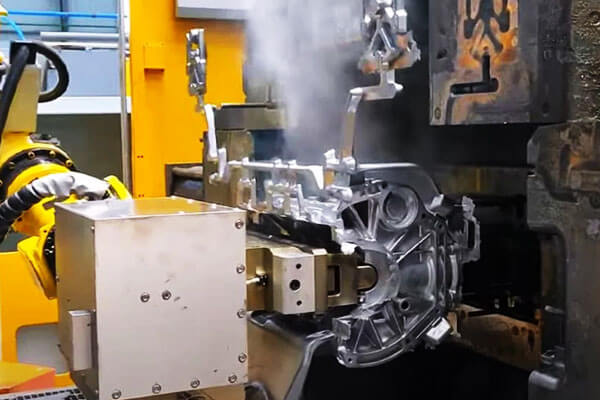
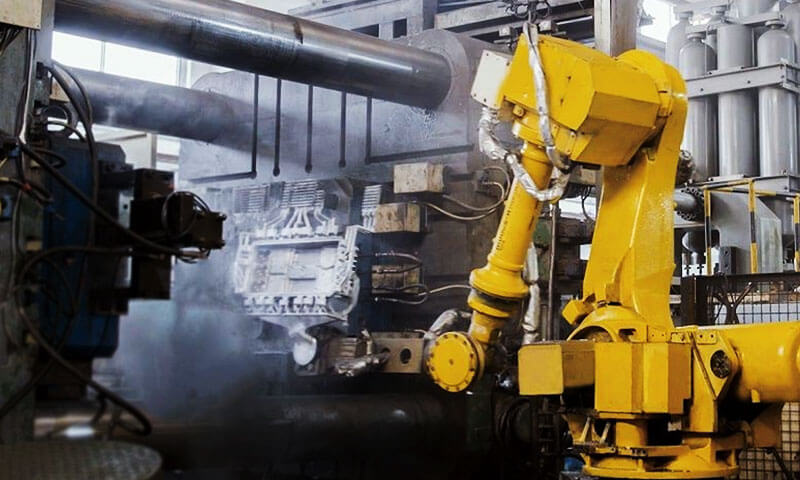
Modern production cells often use industrial robots to extract castings automatically, reducing cycle time while preventing handling damage and improving operator safety.
步 6: Trimming and Finishing
Immediately after ejection, excess material is removed using dedicated trimming dies or machining operations.
Common finishing processes include:
- Flash trimming
- Gate removal
- Deburring
- 射击
- Surface polishing
- 数控加工
- Thread tapping
- Hole drilling
Depending on product requirements, additional processes such as leak testing, 矫直, or heat treatment may also be performed.
步 7: Inspection and Quality Assurance
Quality assurance is integrated throughout the die casting process rather than being limited to final inspection.
Manufacturers typically employ multiple inspection methods, 包括:
| Inspection Method | Primary Purpose |
| 视觉检查 | Detect surface defects, 闪光, 裂缝, and incomplete filling |
| 协调测量机 (CMM) | Verify dimensional accuracy and geometric tolerances |
| X射线检查 | Identify internal porosity, 收缩腔, 和夹杂物 |
| CT扫描 | Analyze complex internal structures without sectioning |
| 染料渗透剂测试 | Reveal fine surface cracks |
| Pressure leak testing | Evaluate sealing performance for fluid-handling components |
| Tensile and hardness testing | Confirm mechanical property compliance |
| Metallographic analysis | Examine grain structure, 金属间相, and porosity distribution |
3. 铸造过程的类型
Die casting is not a single manufacturing technique but a family of high-pressure metal forming processes developed to meet different material characteristics, product geometries, 机械要求, 和生产量.
Selecting the appropriate die casting method is often one of the most important engineering decisions because it directly affects product quality, 生产效率, 工具投资, and overall manufacturing cost.
Among the various processes available today, hot chamber die casting, cold chamber die casting, 真空铸造, squeeze die casting, semi-solid die casting, 和 低压铸造 represent the most widely adopted technologies in modern manufacturing.
Hot Chamber Die Casting
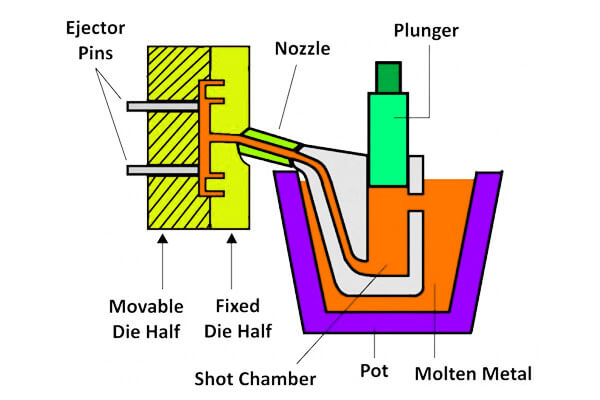
Hot chamber die casting is characterized by an injection system that remains continuously immersed in the molten metal bath.
The molten alloy is drawn directly into the injection chamber and forced into the die through a gooseneck mechanism.
Because the metal transfer distance is extremely short, the cycle time is remarkably fast, making this process highly suitable for mass production of relatively small components.

过程原理
The production cycle follows these steps:
- Molten metal fills the gooseneck automatically.
- The injection plunger forces molten metal into the die cavity.
- Pressure is maintained during solidification.
- The die opens, and the casting is ejected.
- The injection chamber immediately refills for the next cycle.
The entire cycle often requires only a few seconds.
合适的材料
Hot chamber systems are primarily used for alloys with relatively low melting temperatures, 包括:
- 锌合金
- 镁合金
- Lead alloys
- Tin alloys
These alloys do not aggressively attack the submerged injection components.
优点
- Extremely high production speed
- Short cycle time
- Excellent repeatability
- High productivity
- Low metal oxidation during transfer
- Suitable for thin-wall precision components
- High automation compatibility
限制
- Not suitable for aluminum or copper alloys
- Injection components remain exposed to molten metal
- Limited to low-melting-point alloys
- Generally used for smaller castings
典型的应用
Hot chamber die casting is widely used in:
- 电子外壳
- Automotive hardware
- Locks and hinges
- 装饰硬件
- 消费产品
- 精密连接器
- Medical device components
冷室死亡
Cold chamber die casting is the most common process for aluminum die casting and is extensively used in automotive and structural manufacturing.
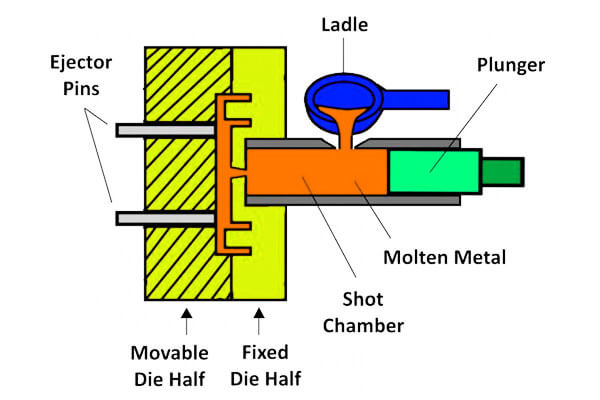
Unlike hot chamber systems, molten metal is poured into a shot sleeve before each injection cycle.

过程原理
The process consists of:
- Molten alloy is transferred from the melting furnace.
- The metal is poured into the shot sleeve.
- A hydraulic piston injects the metal into the die cavity.
- High pressure is maintained during solidification.
- The casting is ejected after cooling.
Because the injection chamber is not continuously immersed in molten metal, cold chamber machines can process higher-temperature alloys without excessive equipment wear.
合适的材料
Cold chamber die casting is commonly used for:
- 铝合金
- 铜合金
- 黄铜
- High-strength magnesium alloys
优点
- Suitable for high-strength engineering alloys
- Produces large structural castings
- 出色的尺寸精度
- 良好的机械性能
- Compatible with vacuum-assisted systems
- Ideal for automotive structural components
限制
- Slightly slower production cycles
- Additional metal transfer step
- Higher energy consumption
- Greater risk of oxidation if metal handling is not optimized
典型的应用
Cold chamber die casting dominates industries requiring structural strength, 包括:
- 发动机块
- 传输外壳
- EV battery enclosures
- 电机外壳
- 变速箱
- 工业机械
- 航空航天结构部件
真空铸造
Vacuum die casting introduces a controlled vacuum inside the die cavity immediately before metal injection.
Removing air from the cavity significantly reduces gas entrapment, one of the primary causes of porosity in conventional die casting.
过程特征
Compared with conventional die casting, vacuum-assisted systems provide:
- Lower gas porosity
- Improved internal density
- 更好的机械性能
- Reduced blister formation
- 提高了焊接性
- Enhanced heat treatment capability
Vacuum die casting has become the preferred technology for manufacturing safety-critical aluminum components used in electric vehicles and lightweight automotive structures.
典型的应用
Typical products include:
- Automotive shock towers
- 悬架组件
- Structural body nodes
- Battery housings
- 底盘组件
Squeeze Die Casting
Squeeze die casting combines characteristics of forging and die casting by applying very high pressure throughout the entire solidification process.
Instead of simply filling the cavity rapidly, the molten metal solidifies while subjected to continuous compressive force.
过程特征
The process offers several unique advantages:
- Nearly pore-free microstructure
- High material density
- Fine grain refinement
- Superior fatigue strength
- Excellent pressure tightness
- Mechanical properties approaching forged components
Because shrinkage porosity is greatly reduced, squeeze die casting is often selected for highly loaded structural components.
限制
The process generally involves:
- Longer cycle times
- Higher equipment costs
- Larger clamping forces
- More complex process control
典型的应用
常见应用包括:
- 悬架武器
- 转向指关节
- 制动卡钳
- 航空托架
- Heavy-duty hydraulic components
半固体模具铸造
Semi-solid die casting, 也称为 触变铸造 或者 流变铸造, processes metal in a partially solidified state rather than as a fully liquid melt.
The alloy exhibits thixotropic behavior, flowing under pressure while maintaining a globular microstructure.
Process Advantages
Compared with conventional die casting, semi-solid processing offers:
- Reduced turbulence during filling
- 降低收缩
- 孔隙率降低
- Excellent dimensional stability
- Improved mechanical properties
- Better heat treatability
- Lower die erosion
Because the metal flow is more controlled, semi-solid processing is particularly effective for producing complex structural components requiring high integrity.
限制
Despite its technical advantages, semi-solid casting requires:
- Specialized billet preparation
- Sophisticated temperature control
- Higher equipment investment
- More demanding process management
典型的应用
Industries adopting semi-solid die casting include:
- 航天
- 电动汽车
- Medical equipment
- Precision robotics
- High-performance automotive systems
低压铸造
Low-pressure die casting differs fundamentally from high-pressure die casting.
Instead of injecting metal at extremely high velocity, compressed gas gently pushes molten metal upward through a riser tube into the die cavity.
The slower filling process minimizes turbulence and oxide formation.
过程特征
Major benefits include:
- Smooth laminar metal flow
- Lower inclusion levels
- Improved pressure tightness
- Excellent metallurgical quality
- 高材料利用
- Reduced oxidation
然而, production cycles are significantly longer than conventional die casting.
典型的应用
Low-pressure die casting is frequently selected for:
- Aluminum wheels
- 气缸盖
- 泵外壳
- Compressor casings
- Large pressure-tight components
4. Die Casting Equipment and Tooling

The Die Casting Machine
| 成分 | 功能 |
| Injection system | Hydraulic plunger or piston that forces metal into the die. |
| 射击袖 | Cylinder where metal is held before injection (cold‑chamber). |
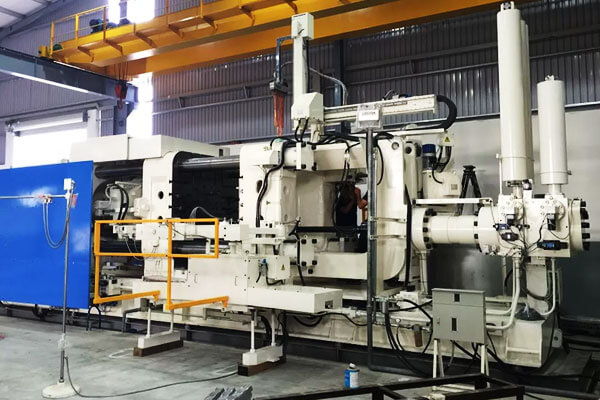
| Die clamping unit | Hydraulic toggle or direct‑actuated clamp that holds the die halves shut during injection. Clamping force: 100‑5,000 tons. |
| Die half (固定的) | Stationary half mounted on the machine. Contains the sprue and runner system. |
Die half (moving) |
Movable half that opens to eject the casting. Contains ejector pins. |
| Ejection system | Hydraulic or mechanical pins that push the casting out of the die after opening. |
| Cooling system | Water channels in the die regulate temperature (typically 150‑250°C). |
| Lubrication system | Applies release agent to the die cavity before each shot. |
Die Design Principles
The die (工具) is the most expensive component in die casting (typically $30,000‑200,000+). Its design dictates part quality, 周期, 和工具寿命.
| Design element | 原则 |
| Parting line | The plane where the two die halves separate. Locate to allow easy ejection and minimal flash. |
| 拔模角 | Taper on vertical walls to allow part removal: typically 0.5‑2° (internal surfaces require more). |
| Gating system | 频道 (跑步者和大门) that direct metal from the shot sleeve into the cavity. Gate location and size control fill pattern and minimize turbulence. |
Overflows (通风口) |
Cavities at the end of fill that trap cold metal and air; allow gases to escape. |
| 冷却通道 | Strategically placed water lines for thermal control. Even cooling reduces distortion and porosity. |
| Ejector pins | Located on the moving die half to push the casting out after opening. |
| Slides and cores | Movable die elements that create undercuts (例如。, holes in side walls). Increase die cost but enable more complex geometries. |
5. Die Casting Alloy Systems
铝合金 (Cold‑Chamber Dominant)
| 合金 | 作品 | 拉伸 (MPA) | 屈服 (MPA) | 伸长 (%) | 关键特征 | 应用领域 |
| A380 | Al‑Si‑Cu (8.5% 和, 3.5% 铜) | 320‑340 | 160‑180 | 2‑4 | 出色的铸造性, 优势, 耐腐蚀性 | 发动机块, 传输外壳, 阀体 |
| A383 (ADC12) | Al‑Si‑Cu (9.5% 和, 2.5% 铜) | 300‑330 | 150‑170 | 2‑3 | Better die‑filling than A380; less soldering | 电子外壳, 汽车零部件 |
| A360 | Al‑Si‑Mg (9% 和, 0.5% 毫克) | 310‑330 | 160‑180 | 3‑5 | Better ductility than A380; 较高的耐腐蚀性 | 海洋硬件, 精密住房 |
| A413 | Al‑Si (12% 和) | 290‑310 | 150‑160 | 2‑4 | 高流动性; excellent for thin‑wall parts | 泵主体, carburetors |
| A356 | Al‑Si‑Mg (7% 和, 0.3% 毫克) | 260‑290 | 180‑200 | 8‑10 | Highest ductility; heat‑treatable (T6) | 结构成分 (with vacuum assist) |
锌合金 (Hot‑Chamber Dominant)
| 合金 | 作品 | 拉伸 (MPA) | 伸长 (%) | 硬度 (HB) | 应用领域 | |
| 负载 2 | Zn‑Al‑Cu (4% al, 3% 铜) | 360‑400 | 7‑10 | 100‑130 | 高力量; 衬套, 齿轮 | |
| 负载 3 | Zn‑Al (4% al) | 250‑280 | 10‑15 | 80‑90 | 最常见; 出色的铸造性, 表面饰面 | 硬件, 玩具, 汽车装饰 |
| 负载 5 | Zn‑Al‑Cu (4% al, 1% 铜) | 280‑320 | 7‑10 | 90‑100 | Better strength than Zamak 3 | 铰链, 手柄, 紧固件 |
| ZA-8 | Zn‑Al (8% al) | 370‑420 | 5‑8 | 100‑115 | 高力量; creep‑resistant | Pulleys, clutches |
镁合金
| 合金 | 作品 | 拉伸 (MPA) | 屈服 (MPA) | 伸长 (%) | 应用领域 | |
| AZ91D | Mg‑Al‑Zn (9% al, 0.7% Zn) | 230‑250 | 150‑160 | 3‑5 | Most common Mg die‑cast alloy | Automotive instrument panels, 电子外壳 |
| AM60B | Mg‑Al‑Mn (6% al) | 220‑240 | 120‑140 | 8‑12 | Higher ductility than AZ91D | 汽车车轮, 方向盘 |
6. Process Parameters That Determine Casting Quality
在高压铸造中, product quality is governed not by a single variable but by the precise coordination of multiple process parameters.
Metal flow, cavity filling, 凝固, and pressure transmission occur within milliseconds, meaning even minor deviations can lead to defects such as porosity, 冷关, 闪光, 或尺寸不稳定.
Modern die casting therefore relies on closed-loop process control, 实时监控, and statistical process optimization to ensure consistent production.
注入压力: Driving Complete Cavity Filling
Injection pressure provides the force required to propel molten metal through the gating system and into every section of the die cavity.
用于铝合金, injection pressures typically range from 30 到 175 MPA, depending on the casting size, 壁厚, and machine capacity.
If the pressure is insufficient:
- Molten metal may fail to fill thin-wall sections completely.
- Shrinkage cavities and gas porosity become more likely.
- Surface finish deteriorates due to incomplete cavity replication.
反过来, excessively high pressure can create new challenges:
- Flash at the parting line
- Increased mechanical stress on the die
- Accelerated die wear and fatigue
- Higher risk of dimensional distortion
The optimal injection pressure achieves complete filling while maintaining die longevity and process stability.
Shot Velocity: Balancing Filling Speed and Flow Stability
Shot velocity determines how rapidly molten metal enters the die cavity.
Aluminum die casting commonly uses filling velocities between 1 和 5 多发性硬化症, although local gate velocities may be significantly higher.
A filling speed that is too low often results in:
- Premature solidification
- 冷关
- 错误
- Incomplete filling of thin sections
Excessive velocity, 然而, increases turbulence inside the cavity, 导致:
- Air entrapment
- Oxide film formation
- 气孔隙度
- Surface flow marks
The objective is to achieve high-speed yet laminar filling, minimizing turbulence while ensuring the cavity is completely filled before solidification begins.
死温度: Controlling Solidification Behavior
Die temperature has a direct influence on cooling rate, 金属流, 表面饰面, 和维稳定性.
用于铝合金, die temperatures are generally maintained between 150°C and 250°C
A die operating below the optimal temperature may cause:
- 冷关
- Poor surface replication
- 填充不完全
- Increased sticking during ejection
If the die becomes excessively hot:
- Molten metal may solder to the die surface
- Cycle times increase due to slower cooling
- Internal porosity becomes more pronounced
- Thermal fatigue of the die accelerates
Rather than focusing solely on average die temperature, manufacturers prioritize uniform thermal distribution across the mold to ensure consistent solidification throughout the casting.
Molten Metal Temperature: Maintaining Fluidity Without Excessive Oxidation
The pouring temperature must provide adequate fluidity while minimizing oxidation and gas absorption. Aluminum alloys are typically poured between 620°C 和 720°C
Insufficient melt temperature can result in:
- Poor fluidity
- 冷关
- 错误
- 粗糙的表面饰面
Excessive pouring temperatures increase the likelihood of:
- Hydrogen absorption
- Oxide inclusion formation
- 气孔隙度
- Die erosion
- Coarser microstructures
Maintaining a stable melt temperature throughout production is essential for repeatable casting quality.
Intensification Pressure: Reducing Shrinkage During Solidification
After the cavity is filled, an additional 强化压力, 通常 two to three times the initial filling pressure
This secondary pressure serves several important functions:
- Compensates for solidification shrinkage
- Improves casting density
- Reduces shrinkage porosity
- 增强机械性能
- Improves pressure tightness
然而, excessive intensification pressure may force molten metal into die clearances, increasing flash formation and imposing higher mechanical loads on the tooling.
所以, pressure must be carefully matched to both the alloy and component geometry.
周期: Balancing Productivity and Quality
Cycle time determines overall manufacturing efficiency and consists of injection, 凝固, die opening, 弹射, 润滑, and die closing.
Typical aluminum die casting cycle times range from 10 到 60 秒
An unnecessarily long cycle reduces production efficiency and increases manufacturing cost.
相比之下, an overly short cycle may eject the casting before adequate solidification has occurred, 导致:
- 失真
- 翘曲
- 表面损伤
- 维度不稳定
Optimizing cycle time requires balancing throughput with sufficient cooling to maintain consistent part quality.
Vacuum Assistance: A Key Technology for High-Integrity Castings
Conventional high-pressure die casting often traps air inside the cavity during high-speed filling.
Vacuum-assisted die casting addresses this issue by evacuating the cavity to approximately 10–50 kPa before metal injection.
Compared with conventional die casting, vacuum assistance offers several important advantages:
- Reduces trapped air by 70–90%
- Significantly lowers gas porosity
- Improves density and structural integrity
- Increases fatigue performance
- Enables subsequent T5或T6热处理 without blister formation
- Improves weldability for structural components
因此, vacuum die casting has become the preferred technology for manufacturing safety-critical aluminum components such as automotive body structures, 电池外壳, 悬架零件, and electric vehicle chassis components.
过程集成: The Importance of Parameter Coordination
Each process parameter influences the others. Increasing shot velocity without improving venting may increase gas porosity;
raising pouring temperature without adjusting die cooling can accelerate die erosion; higher injection pressure may reduce shrinkage defects but increase flash if clamping force is insufficient.
最后, leading die casting manufacturers no longer optimize parameters individually.
反而, they employ integrated process windows, combining real-time sensors, cavity pressure monitoring, thermal imaging, and Statistical Process Control (SPC) to maintain every variable within a stable operating range.
This systems-based approach minimizes process variation, 提高重复性, 延长生命, and consistently delivers high-quality castings for demanding industrial applications.
7. Surface Treatment and Secondary Operations
Although die casting can produce components with excellent dimensional accuracy and surface quality directly from the mold, many products require secondary operations to meet functional, cosmetic, or assembly requirements.
These post-processing steps enhance corrosion resistance, 佩戴性能, 外貌, and dimensional precision while preparing the casting for its final application.
Trimming and Flash Removal
Immediately after ejection, excess material generated by the gating system, overflow wells, and parting lines must be removed.
常见方法包括:
- Hydraulic trimming presses
- CNC修剪
- Band saw cutting
- Robotic deburring
- Manual finishing for complex parts
Efficient trimming reduces handling time and prepares the casting for downstream processing.
表面清洁和整理
Residual lubricants, 氧化物, and burrs are removed to improve surface quality.
Typical cleaning methods include:
- 射击
- Glass bead blasting
- 振动整理
- 沙子爆破
- Ultrasonic cleaning
- Chemical cleaning
The selected method depends on the required surface roughness and subsequent finishing operations.
精密加工
While die casting produces near-net-shape parts, critical features often require machining to achieve tight tolerances.
Typical machining operations include:
- CNC铣削
- 钻孔
- 旋转
- 窃听
- Thread milling
- 转身
- Surface grinding
High-pressure die casting minimizes machining allowances, reducing production costs compared with conventional castings.
热处理
Some die-cast alloys can undergo heat treatment to enhance mechanical performance.
常见治疗包括:
- 人工衰老
- 缓解压力
- 解决方案处理 (for specially developed low-porosity alloys)
- T5 and T6 heat treatment for selected vacuum or squeeze die castings
Conventional high-pressure die castings containing significant gas porosity are generally unsuitable for solution heat treatment due to the risk of blister formation.
Surface Coating Technologies
Surface treatments improve both functional performance and visual appeal.
粉末涂料
提供:
- 优异的耐腐蚀性
- Wide color selection
- 高耐用性
- Good UV resistance
阳极氧化
Mainly used for aluminum alloys to produce:
- Hard oxide layers
- Improved wear resistance
- 增强的腐蚀保护
- Decorative finishes
High-quality anodizing requires alloys with controlled silicon and copper contents, as excessive alloying elements may affect color uniformity.
电镀
常见的涂料包括:
- 镍
- 铬合金
- 锌
- 铜
Electroplating enhances appearance, 戴阻力, and electrical performance.
电泳涂装 (电子涂层)
优惠:
- Uniform film thickness
- 优异的耐腐蚀性
- 高生产效率
- Strong adhesion
Widely used for automotive components requiring durable protective coatings.
8. Typical Defects in Die Casting: 原因和补救措施
Despite its high precision and productivity, die casting remains susceptible to a range of manufacturing defects.
Most defects originate from disturbances in metal flow, 热管理, gas evacuation, or die condition.
Understanding their root causes is essential for implementing effective corrective actions.
| 缺点 | Typical Causes | Engineering Remedies |
| 气孔隙度 | Air entrapment, insufficient venting, poor vacuum, turbulent filling | Improve vent design, apply vacuum assistance, optimize injection speed, degas molten metal |
| 收缩孔隙度 | Inadequate pressure during solidification, uneven wall thickness, 热点 | Increase intensification pressure, redesign wall sections, optimize cooling and gating |
| 冷关 | Low metal temperature, slow filling, poor gate design | Increase melt/die temperature, optimize gate location, increase filling velocity |
| 埃及 | Premature solidification, insufficient fluidity, inadequate shot volume | Raise pouring temperature, enlarge gates, improve flow balance |
| 闪光 | Insufficient clamping force, worn die surfaces, 压力过大 | Increase clamping force, repair parting surfaces, optimize injection pressure |
| 焊接 (Die Sticking) | Excessive die temperature, improper lubricant application, unsuitable alloy chemistry | Improve die cooling, optimize lubrication, apply die surface coatings |
Heat Checking |
Repeated thermal cycling, inadequate die steel performance | Use premium H13 steel, optimize cooling, apply nitriding or PVD coatings |
| Surface Blisters | Entrapped gas expands during secondary heating or coating | Improve vacuum efficiency, reduce gas porosity, avoid excessive heating |
| Flow Marks | Unstable metal flow, improper gate position, low injection speed | Redesign gating system, adjust filling speed, 优化模具温度 |
| 翘曲 | 冷却不均匀, 残余应力, 壁厚不均匀 | Balance cooling channels, maintain uniform sections, optimize ejection timing |
| 包含 | 氧化物, 矿渣, refractory contamination | Improve melt cleanliness, install ceramic filters, 最大限度地减少浇注过程中的湍流 |
| Dimensional Deviation | Thermal distortion, die wear, unstable process parameters | Monitor die temperature, maintain tooling, implement SPC and regular calibration |
9. Die Casting vs Other Manufacturing Processes
Selecting the optimal manufacturing process requires balancing multiple engineering factors,
including production volume, 维度的准确性, material utilization, 机械性能, 工具投资, and total manufacturing cost.
| Comparison Factor | 压铸 | 熔模铸造 | 沙子铸造 | 数控加工 |
| Primary Materials | 铝, 锌, 镁 | 钢, 不锈钢, 超级合金, 铝 | Almost all cast alloys | Nearly all metals |
| 维度的准确性 | 出色的 (CT4-CT7) | 很高 (CT4 -CT6) | 一般 (CT8–CT13) | 极高 |
| 表面处理 | 出色的 (RA1.6-3.2μm) | 出色的 (RA3.2-6.3μm) | Relatively Rough | 出色的 |
| 零件复杂性 | 高的 | 很高 | 一般 | 很高 |
| 壁厚能力 | 0.8–3毫米 | 2–10毫米 | >4 毫米 | Depends on machining accessibility |
| 机械性能 | 良好 | 非常好 | 良好 | Depends on base material |
Internal Density |
中度至高 (真空: 高的) | 高的 | 一般 | Solid material |
| 生产量 | 很高 | 中等的 | 低至中等 | 低至中等 |
| 周期 | 秒数 | 天 | 小时 | Minutes to Hours |
| 工具成本 | 很高 | 一般 | 低的 | 低的 |
| 单位成本 (高量) | 非常低 | 中等的 | 高的 | 高的 |
| 物质利用 | 高的 | 一般 | 一般 | 低的 |
| Typical Industries | 汽车, 电子产品, 消费产品 | 航天, 医疗的, 活力 | 重型设备 | 精密工程 |
10. Innovations and Future Trends in Die Casting
| 创新 | 描述 | 影响 |
| High‑vacuum die casting | Cavity evacuated to <50 毫巴 | Enables heat treatment; improves fatigue; 降低孔隙率. |
| 挤压铸造 | Pressure applied during solidification (100‑200 MPa) | Eliminates porosity; allows thick sections; can cast wrought alloys. |
| Semi‑solid (触变铸造) | Metal is partially solidified before injection | Reduces porosity; improves surface finish; extended die life. |
| Additive‑manufactured dies | 3D‑printed die inserts with conformal cooling | Reduces cycle time; improves thermal uniformity; 延长生命. |
AI‑driven process control |
Real‑time monitoring of pressure, 温度, and plunger velocity | Predicts defects; adjusts parameters automatically; reduces scrap. |
| Lightweight structural castings | 大的, high‑strength aluminum castings for EV battery trays and chassis | Enables automotive lightweighting; growth in large‑die casting (5,000+ ton machines). |
| Green die casting | Water‑based lubricants; electric melting; 废料回收 | Reduces emissions; lowers energy consumption. |
11. 结论
Die casting is an irreplaceable core near-net-shape forming process in modern precision manufacturing and lightweight industrial production.
Its unique high-speed high-pressure filling mechanism, ultra-high production efficiency, 优异的尺寸精度,
and broad alloy adaptability make it the preferred process for mass production of non-ferrous alloy precision components.
Hot-chamber, 冷室, 高压, 低压, and vacuum die casting processes form a complete technical system, covering low-precision mass parts to high-strength structural precision parts.
Although traditional die casting has inherent defects such as micro-porosity, continuous technological optimization including vacuum assistance, simulation prediction, and intelligent parameter control has greatly improved product performance and application boundaries.
With the rapid development of new energy vehicles, intelligent electronics, and aerospace lightweight manufacturing,
die casting technology will continue to iterate toward integration, intelligence, 高精度, 和高力量, becoming a core driving force for the upgrading of modern metal precision manufacturing industry.
常见问题解答
What is the essential difference between hot-chamber and cold-chamber die casting?
Hot-chamber die casting integrates melting and injection systems, suitable for low-melting-point zinc-based alloys with fast cycle speed.
Cold-chamber die casting separates melting and injection, applicable to high-melting-point aluminum, 镁, and copper alloys with higher injection pressure and wider industrial applicability.
Why cannot traditional high-pressure die-cast parts be heat-treated?
Traditional HPDC processes easily entrap air to form internal micro-porosity.
Conventional heat treatment will cause internal gas expansion, generating bubbling and deformation defects on the part surface.
Vacuum die casting effectively solves this problem and supports heat treatment strengthening.
How to effectively eliminate die casting porosity defects?
Adopt vacuum die casting system, optimize staged injection speed to avoid turbulent flow, strengthen molten metal degassing and slag removal,
improve mold venting structure, and stabilize mold temperature field to comprehensively reduce gas entrapment and porosity.
What production scenarios are not suitable for die casting?
Die casting is not applicable for low-batch customized parts (high mold cost), high-toughness impact-resistant structural parts (inherent porosity limits toughness), and high-melting-point steel alloy components.