

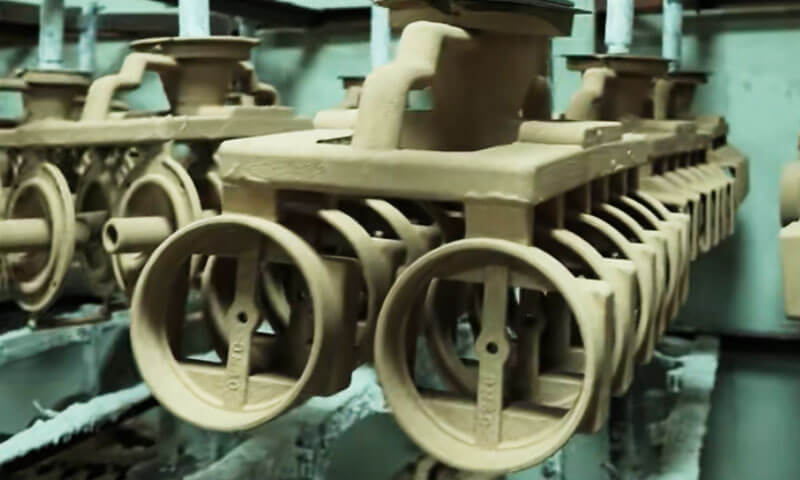
在精密铸造中, 浇注系统是将熔融金属从钢包或熔炉喷嘴引导至模具型腔的完整通道.
浇注系统不仅仅是一个“浇注通道”。它是铸件的血管网络. 它控制流量稳定性, 夹渣, 气体排出, 灌装顺序, 和喂养.
如果浇注系统错误, 铸件会出现孔隙, 渣孔, 冷关, 流线, 错误, 或收缩——无论其余过程有多好.
本指南介绍了我在车间使用的评估标准.
1. 什么是铸造浇注系统?
铸造浇注系统是一个通道网络,用于将熔融金属从浇包或炉喷嘴引导到模具型腔中.
它控制金属如何进入, 流过, 并在凝固开始之前填充型腔.
在实际铸造工程中, 浇注系统的功能与铸件的循环网络非常相似: 其设计直接影响灌装稳定性, 夹杂物控制, 气体排出, 饲养条件, 和整体铸造质量.
正确设计的浇注系统不仅仅是提供足够的熔融金属.
它必须调节流速, 最大限度地减少湍流, 防止炉渣和氧化物夹杂物进入型腔, 提供合适的填充顺序, 并避免过早切断进料路径.
这些要求尤其重要 投资铸造, 其中薄陶瓷壳必须承受熔融金属的热和机械冲击.
设计不当的内浇口可能会腐蚀外壳表面涂层, 介绍陶瓷夹杂物, 或引起局部湍流.
用于砂型铸件, 金属速度过高可能会腐蚀模具表面, 产生夹杂砂, 并影响尺寸精度.
从铸造工程的角度来看, 四个基本功能定义了浇注系统:
- 流量稳定: 顺利输送熔融金属, 没有过度的湍流, 溅起, 或空气夹带.
- 夹杂物控制: 防止夹渣, 氧化物, 耐火颗粒, 和其他污染物进入铸件.
- 排气: 在填充过程中允许排出的空气和模具气体逸出.
- 受控灌装和喂料: 以合适的顺序填充型腔,同时在凝固过程中保持所需的补缩条件.
当这些功能协同工作时, 气孔风险, 炉渣夹杂物, 冷关, 错误, 流痕, 并可大幅减少相关铸造缺陷.
2. 铸造浇注系统的主要组成部分
传统的浇注系统由四个主要组件组成: 浇注盆, 泉水, 跑步者, 和内盖特.
每个组件都有不同的功能, 它们的尺寸和相对位置必须被视为一个集成系统.
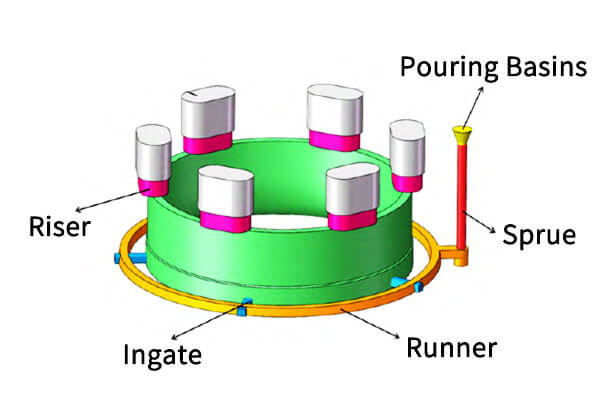
浇注盆 (倒杯)
浇注盆接收来自钢包或熔炉的熔融金属并将其导入浇口. 它提供了一个稳定的入口点,有助于在浇注过程中保持连续的金属流.
其主要功能包括:
- 减少熔融金属进入浇注系统时的直接冲击和过度飞溅.
- 在浇口入口上方保持相对稳定的金属头.
- 允许一些大的漂浮污染物保留在表面附近,而不是立即进入浇口.
- 支持一致的倾倒并降低吸入空气的风险.
设计不当的浇注盆可能会导致紊流, 间歇金属输送, 和空气夹带.
因此,其几何形状应支持顺利流入浇道,而不会产生不必要的限制.
浇口
浇道是将熔融金属从浇注池输送到流道的垂直通道. 它建立了驱动金属通过浇注系统的金属静压头.
正确设计的浇道通常是锥形的, 顶部横截面较大,底部横截面较小.
这种几何形状有助于浇道在浇注过程中保持充满状态,并降低空气被吸入金属流的风险.
关键设计考虑因素包括:
- 锥度: 横截面积应沿流动方向适当减小,以适应金属速度的增加.
- 浇口高度: 可用的金属静压头会影响流速和填充行为.
- 浇口井: 尺寸合适的浇道井可以减少金属进入流道的冲击和湍流.
- 流动连续性: 应避免横截面突然变化或急剧过渡.
浇口过大或锥度不佳可能会导致空气吸入和流动不稳定. 浇道尺寸过小会限制金属供应并导致填充不完全.
跑步者
流道是将熔融金属从浇道分配到一个或多个内浇口的水平或接近水平的通道.
它也是控制炉渣运动的重要场所, 氧化物, 和其他内含物.
跑步者执行三个主要功能:
- 将熔融金属分配到不同的内浇口或模具型腔.
- 在金属进入铸件之前帮助稳定流动.
- 提供支持分离和保留某些非金属夹杂物的空间和流动条件.
流道设计必须考虑横截面积, 长度, 流动方向, 分支几何, 和内浇口的位置.
方向或截面的突然变化会产生湍流并增加氧化膜形成的可能性.
在适当的情况下, 跑步者延伸, 集渣器, 过滤器, 和其他夹杂物控制功能可以提高清洁度.
然而, 跑步者不应被视为对抗所有包容性的绝对障碍. 其有效性取决于合金, 浇注温度, 流速, 浇口几何结构, 以及污染物的性质.
怎么样
内浇口是熔融金属进入模具型腔的最后通道. 直接影响填充速度, 流动方向, 灌装顺序, 以及铸件内的热分布.
与主流道和流道不同, 主要运输和配送金属, 内浇口决定金属如何与实际铸造几何形状相互作用.
重要的设计考虑因素包括:
- 内浇口横截面积: 控制进入型腔的金属量和速度.
- 内门位置: 确定初始填充区域并影响整体填充顺序.
- 指明方向: 应避免对薄模具部分的直接影响, 内核, 和脆弱的陶瓷外壳表面.
- 内浇口厚度: 影响局部冷却以及铸造和浇注系统之间连接的持续时间.
- 内浇口数量: 可能需要多个内浇口才能将金属均匀地分布在大型或复杂的铸件上.
适用于复杂的熔模铸造, 内浇口通常位于较厚部分或选定区域附近,金属可以进入这些区域而不会损坏陶瓷壳.
然而, 最终安排必须平衡填充行为与凝固和补给要求.
3. 有效浇注系统的关键设计原则
浇注系统应作为完整的流动控制和凝固支持系统进行评估. 快速填充模具的设计不一定是好设计.
速度过高可能会产生湍流和夹杂物, 而速度不足可能会导致过早冻结和不完全填充.
以下原则为浇注系统设计提供了实用的框架.
确保顺利, 稳定的金属流动
第一个要求是以受控的速度和最小的湍流将熔融金属输送到模具型腔中.
不稳定的流量会导致一些问题:
- 空气夹带和氧化膜形成.
- 飞溅及二次氧化.
- 模具或陶瓷壳侵蚀.
- 砂内含物, 陶瓷夹杂物, 和表面缺陷.
- 填充不均匀和局部温差.
在沙子铸造中, 高速金属会侵蚀模具表面并将砂粒带入型腔.
在熔模铸造中, 浓缩的金属流可能会损坏陶瓷表面涂层, 特别是在尖角或薄壳部分.
提高流动稳定性, 工程师应避免横截面突然变化, 不必要的急转弯, 内浇口位置不佳, 和局部速度过大.
浇道之间的平滑过渡, 跑步者, 和内浇口有助于减少流动分离和冲击.
同样重要的是要认识到湍流不仅仅由内浇口速度决定.
合金特性, 浇口几何结构, 模具布局, 浇注高度, 流入流与腔壁之间的相互作用都会影响实际的流动模式.
提供可靠的炉渣和夹杂物控制
炉渣和非金属夹杂物会显着降低铸件质量, 特别是在需要气密性的部件中, 疲劳性抗性, 或干净的机加工表面.
流道通常是夹杂物控制功能的主要位置,因为它提供了在金属到达内浇口之前分离污染物的机会.
常见的设计措施包括:
- Providing sufficient runner volume for flow stabilization and inclusion separation.
- Using runner extensions or slag traps to collect contaminants.
- Positioning ingates so that they do not draw floating slag directly into the cavity.
- Applying ceramic foam filters or other suitable filtration methods where required.
- Avoiding excessive pouring turbulence that can break up surface oxides and carry them into the metal.
The effectiveness of slag control depends on the density, 尺寸, and behavior of the inclusions.
Large floating slag particles may be retained relatively easily, while fine oxides and suspended inclusions are more difficult to separate.
所以, gating design should work together with melt treatment, ladle cleanliness, and pouring practice.
建立合理的灌装顺序
The filling sequence determines how molten metal reaches different areas of the mold. A well-designed system should fill the cavity completely before excessive local solidification prevents further flow.
Several practical guidelines are commonly considered:
- Fill distant regions without leaving them until the end: The gating arrangement should prevent remote or difficult-to-reach sections from becoming isolated.
- Prioritize thin sections where premature freezing is likely: Thin walls lose heat quickly and require sufficient filling temperature and flow capacity.
- Avoid unnecessary flow interference: Multiple streams should not collide in a way that traps air or creates oxide films.
- Maintain adequate thermal conditions: The filling process must be fast enough to avoid cold shuts and misruns, but not so fast that it creates severe turbulence.
- Coordinate filling with feeding: The gating and feeding systems should be designed together to support the intended solidification sequence.
The traditional principle of “fill the thin and distant sections reliably, then allow thicker regions to solidify and feed properly” is useful, but it should not be treated as a universal fixed sequence.
Actual filling order depends on casting geometry, ingate location, 合金特性, 模具温度, and the thermal conditions of the process.
适用于复杂铸件, flow simulation can help identify incomplete filling, stream collision, 滞留空气, and unfavorable temperature distribution before tooling or mold production begins.
保持有效的气体排出
As molten metal enters the mold cavity, it displaces the air already present. 此外, 水分, binders, 涂料, and other mold materials may generate gases under high temperatures.
If these gases cannot escape efficiently, they may become trapped and form gas porosity, 吹孔, or surface defects.
An effective gating design should therefore avoid blocking the natural gas-escape paths. Depending on the mold process, gas evacuation may rely on:
- Parting-line gaps and designed venting channels.
- Dedicated vents at high points and cavity dead ends.
- Permeable sand or suitable shell-mold structures.
- Properly designed core vents.
- Controlled filling patterns that prevent premature sealing of escape routes.
在熔模铸造中, the ceramic shell’s permeability and the mold configuration influence gas release. The gating layout should not force metal to close off critical venting paths too early.
A key engineering point is that gas defects are not always caused by inadequate venting alone.
水分, excessive binder decomposition, poor melt quality, and turbulent filling can also contribute. Effective defect prevention requires evaluating the entire molding and pouring process.
协调浇注设计与凝固和补缩
One of the most important requirements is that the gating system must not interfere with the intended solidification sequence.
During cooling, thick sections generally retain heat longer than thin sections.
These thicker regions may become hot spots where shrinkage cavities or shrinkage porosity develop if sufficient liquid metal is unavailable during solidification.
A sound casting design should aim to ensure that:
- The main casting hot spots solidify after surrounding sections.
- Risers or other feeding sources remain liquid long enough to compensate for solidification shrinkage.
- Feeding channels remain open until the critical sections have completed solidification.
- Ingate freezing does not prematurely isolate regions that still require feeding.
For conventional sand and investment casting, the relationship between casting modulus, riser modulus, ingate dimensions, and local cooling conditions must be evaluated carefully.
The traditional objective of keeping the feeding path open is essential, but the statement that the gating system must always cool more slowly than the casting is too broad. The required thermal behavior depends on the function of each section.
A runner may be designed to solidify relatively early to simplify separation and improve yield, while a specific ingate or feeding connection may need to remain liquid longer to support feeding.
The correct design depends on the casting’s solidification pattern and the position of its feeding sources.
为此原因, gating design and riser design should never be treated as completely independent tasks.
平衡金属产量和铸造质量
A gating system consumes metal that does not become part of the finished casting.
Excessively large runners, 虚假, and ingates increase material consumption, melting costs, and downstream cutting or finishing work.
然而, reducing gating dimensions simply to improve yield can create serious filling and quality problems.
An optimized system should balance:
- Sufficient flow capacity.
- Reliable filling of thin and complex sections.
- Effective inclusion control.
- Appropriate solidification and feeding behavior.
- Ease of gating removal and subsequent machining.
- Metal utilization and production cost.
用于大批量生产, even a small improvement in metal yield can generate substantial savings.
尽管如此, yield optimization should come after stable casting quality has been established.
A high-yield gating system that produces recurring misruns, 包含, or shrinkage defects is not economically efficient.
4. 如何评估浇注系统设计是否正确
A gating system should be evaluated using both casting results and process observations.
No single defect automatically proves that the gating system is responsible, but recurring defects in consistent locations often indicate a design or process-control problem.
The following criteria provide a practical inspection framework.
湍流, 霉菌侵蚀, 和金属冲击缺陷
典型症状:
- Erosion marks or irregular flow patterns on internal casting surfaces.
- Sand wash, 结ab, or local sand inclusions in sand castings.
- Ceramic shell erosion, facecoat peeling, or localized shell damage in investment castings.
- 金属渗透, 粗糙的表面, or irregular metal projections.
- Repeated defects near the ingate or at locations directly exposed to the incoming stream.
可能的原因:
- Excessive ingate velocity.
- Ingate positioned directly opposite a mold wall or vulnerable core.
- Abrupt changes in flow direction.
- Poorly designed sprue-to-runner transitions.
- Insufficient mold or ceramic shell strength.
评估: If erosion or impact defects repeatedly occur near the metal entry region, inspect the ingate position, 流动方向, and local velocity.
A revised ingate orientation, larger flow area, or suitable impact-control feature may help reduce the problem.
炉渣夹杂物, 氧化膜, 和非金属污染
典型症状:
- Black spots or dark inclusions on casting surfaces.
- Slag or oxide particles exposed after machining.
- Non-metallic inclusions detected during radiographic or metallographic inspection.
- Repeated inclusion defects in regions near the ingate or along the metal flow path.
可能的原因:
- Insufficient runner volume or ineffective slag-trap geometry.
- Incorrect runner-to-ingate arrangement.
- Excessive turbulence and secondary oxidation.
- Inadequate melt cleaning or slag removal.
- Poor ladle or pouring practice.
评估: Frequent slag or oxide inclusions suggest that both the gating system and melt-handling process require review.
Check whether the runner provides sufficient flow stabilization, whether ingates draw metal from a contaminated region, and whether filtration or improved melt treatment is necessary.
A short runner, by itself, does not prove poor slag control. Its effectiveness must be judged by its geometry, 流动模式, and the actual inclusion behavior of the alloy.
气体孔隙率和滞留气体缺陷
典型症状:
- Rounded pores or blowholes inside the casting.
- Gas-related defects concentrated near cavity dead ends.
- Porosity at transitions between thick and thin sections.
- Repeated surface blowholes or subsurface gas cavities.
可能的原因:
- Insufficient mold venting or blocked gas-escape paths.
- Excessive filling velocity and air entrainment.
- Ingate direction that causes premature sealing of venting routes.
- Excessive mold moisture or gas generation.
- Poor melt quality or inadequate degassing, 适用的地方.
评估: 第一的, identify the pore morphology and distribution. Rounded pores may indicate gas-related defects, while irregular cavities may suggest shrinkage or other causes.
Then inspect venting locations, 灌装顺序, 模具渗透性, 和融化治疗.
Do not attribute every pore near a thick section to the gating system without examining the solidification conditions.
冷关, 流痕, 和失误
典型症状:
- Thin sections or remote regions remain unfilled.
- Visible lines where two metal streams meet without fusing properly.
- Discontinuous flow marks or surface seams.
- Incomplete filling at thin walls, 狭窄的通道, or complex corners.
可能的原因:
- Insufficient gating cross-sectional area.
- Excessively slow filling.
- Low pouring temperature or excessive temperature loss.
- Poor ingate positioning or an unsuitable filling sequence.
- Inadequate pouring time or unstable metal delivery.
评估: Review the total filling time, ingate dimensions, 金属温度, and flow path.
If the metal loses too much heat before reaching the last-filled region, the gating system may need a more direct flow route, additional ingates, or greater flow capacity.
然而, simply increasing ingate velocity is not always the correct solution. Excessive velocity can create turbulence, 氧化, 和霉菌侵蚀.
The goal is to achieve sufficient filling capacity without compromising flow stability.
缩孔和缩孔
典型症状:
- Shrinkage cavities or dispersed porosity in thick sections.
- Repeated shrinkage defects around hot spots.
- Porosity near thick-to-thin transitions.
- Defects that remain after changes to pouring temperature but follow a consistent solidification pattern.
可能的原因:
- Inadequate riser size or feeding capacity.
- Poor feeding-path continuity.
- Premature ingate or feeding-channel solidification.
- Incorrect riser and ingate positions.
- Unfavorable casting geometry or isolated hot spots.
评估: If shrinkage defects repeatedly occur in the same thick section, examine the local solidification pattern rather than simply increasing the gating area.
The riser must provide sufficient liquid metal for shrinkage compensation, and the feeding path must remain effective until the critical hot spot solidifies.
适用于复杂铸件, solidification simulation and section-based modulus analysis can help determine whether the issue originates from the feeding system, 铸造几何形状, or local cooling conditions.
金属泄漏, 泼溅, 和不稳定的浇注
典型症状:
- Molten metal escapes from the mold or shell.
- Splashing occurs around the pouring basin or sprue.
- Metal flow becomes intermittent or visibly unstable.
- Excessive oxidation, smoke, or surface disturbance occurs during pouring.
可能的原因:
- Incorrect sprue and ingate proportions.
- Poor sprue taper or inadequate sprue filling.
- Insufficient mold assembly integrity.
- Inconsistent pouring rate or pouring height.
- Excessive flow resistance or abrupt changes in channel geometry.
评估: Observe the complete pouring process, not just the final casting.
Check whether the sprue remains full, whether metal enters the runner continuously, and whether the pouring rate matches the designed flow capacity.
Metal leakage may also result from mold assembly or shell integrity problems, so gating geometry should not be considered the only possible cause.
5. 熔模铸造的实用浇注系统设计注意事项
Although the basic principles of gating system design apply across different casting processes, investment casting requires additional attention to ceramic shell integrity, narrow passages, and the thermal behavior of the shell mold.
填充过程中保护陶瓷壳
Investment casting shells are relatively thin compared with conventional sand molds.
The facecoat provides the primary surface that reproduces the casting geometry, so localized high-velocity impact can cause erosion, 破裂, or facecoat damage.
为了降低这种风险:
- Avoid directing the ingate stream straight toward thin shell walls.
- Use suitable ingate orientations and smooth flow transitions.
- Avoid unnecessarily concentrated metal flow.
- Consider the strength and thickness of the ceramic shell when positioning gates.
- Evaluate whether the gating tree allows stable filling without excessive metal impact.
For stainless steel investment castings, these considerations are particularly important because the high pouring temperature places substantial thermal stress on the ceramic shell.
使内浇口尺寸与铸件几何形状相匹配
Investment castings often contain thin walls, 复杂的段落, and varying section thicknesses. A single ingate may not provide uniform filling across the entire cavity.
For components with long flow paths or multiple thin sections, multiple ingates may help reduce filling distance and temperature loss.
For thicker components, ingate location should also support the desired feeding conditions and avoid isolating hot spots.
The number, 尺寸, and position of ingates should be determined according to casting geometry, 合金特性, 浇注温度, and production requirements rather than by applying one fixed ratio to every part.
将门树视为一个完整的系统
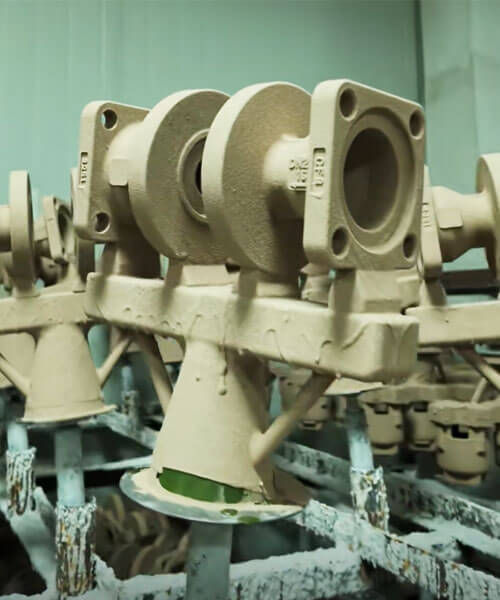
Investment casting commonly uses a tree structure to connect multiple wax patterns to a central sprue. The design must distribute molten metal consistently across all patterns.
An unbalanced gating tree may cause some cavities to fill earlier than others, while remote patterns may experience greater temperature loss or insufficient metal supply.
During evaluation, 考虑:
- The distance between individual patterns and the central sprue.
- The number and position of ingates on each pattern.
- Differences in casting size and wall thickness.
- The filling sequence across the entire tree.
- The thermal condition of the ceramic shell.
- The ease of cutting off gates and finishing the castings.
A well-balanced tree improves filling consistency, reduces variation between castings, and supports more stable batch production.
平衡进料性能和浇口拆除
在熔模铸造中, ingates must provide sufficient metal flow while also allowing practical removal after solidification.
An excessively thin ingate may freeze too early and restrict feeding. An unnecessarily thick ingate can increase metal consumption and gate-removal work, and may leave a larger local finishing area.
The appropriate design should consider both casting quality and downstream operations, including cutting, 磨削, 数控加工, 和表面饰面.
6. 如何优化和验证浇注系统
A reliable gating system should be developed through a combination of engineering calculations, 铸造模拟, trial production, and defect analysis.
步 1: 分析铸件几何形状
Start with the casting itself, not the gating system. Review the 3D model, casting weight, 壁厚分布, 关键维度, 内部段落, and potential hot spots.
Identify thin sections that may freeze prematurely, thick regions that require feeding, and areas vulnerable to direct metal impact.
步 2: 确定填充和饲喂策略
Select appropriate ingate locations and determine how molten metal should enter and move through the cavity.
The design should achieve complete filling without excessive turbulence and should preserve effective feeding paths to critical hot spots.
步 3: 计算浇口尺寸
Estimate the required pouring time, total gating area, sprue dimensions, 流道尺寸, and ingate cross-sections.
The calculations should account for alloy properties, casting volume, metallostatic head, 霉菌状况, 及生产要求.
步 4: 评估流动和凝固行为
For complex or high-value castings, casting simulation can help predict:
- Filling sequence and flow velocity.
- Potential air entrapment and oxide-film formation.
- Incomplete filling and cold-shut locations.
- Temperature distribution during filling.
- Hot spots and predicted shrinkage regions.
- Riser effectiveness and feeding-path continuity.
Simulation results should be interpreted by experienced casting engineers. A visually smooth filling animation does not automatically guarantee clean metal or defect-free castings.
步 5: 进行试铸并检查结果
After the initial design is established, conduct trial production under controlled pouring conditions.
Evaluate the castings using appropriate inspection methods, 例如:
- Visual inspection for surface erosion, 流痕, 以及填充不完全.
- Radiographic testing for internal porosity and inclusions.
- Penetrant testing for surface-breaking defects.
- Ultrasonic testing where material and geometry permit.
- Metallographic examination to identify shrinkage, 包含, and microstructural abnormalities.
- Dimensional inspection to verify casting consistency.
The inspection method should match the defect type, 材料, 铸造几何形状, and applicable customer requirements.
步 6: 根据缺陷分布细化设计
Record the location, 频率, and severity of defects. If defects repeatedly occur in the same region, compare their distribution with the gating layout and solidification pattern.
例如:
- Erosion near an ingate may indicate excessive local velocity or direct metal impact.
- Repeated inclusions along the flow path may indicate inadequate inclusion control or melt cleanliness.
- Misruns at remote thin sections may indicate insufficient filling capacity or excessive temperature loss.
- Shrinkage at thick sections may indicate inadequate feeding rather than insufficient total gating area.
Adjust one or more relevant variables and verify the result through another controlled trial.
This approach is more effective than changing several parameters simultaneously without identifying their individual effects.
7. 为什么浇注系统设计对最终铸造质量很重要
Gating system design directly influences the stability, 一致性, and economic performance of casting production.
A well-designed system reduces unnecessary metal turbulence, improves inclusion control, supports gas evacuation, and maintains suitable filling and feeding conditions.
For precision investment castings, these requirements become even more important because complex geometries, 薄壁, and ceramic shell limitations leave less room for process variation.
不锈钢, 碳钢, 合金钢, and other engineering alloys also have different fluidity, 氧化行为, and solidification characteristics.
Their gating systems should therefore be designed according to the specific alloy and casting geometry.
在 Langhe行业, gating system design is considered an integral part of the investment casting process rather than a separate tooling detail.
From initial 3D model evaluation and ingate positioning to mold filling analysis, trial casting, 和缺陷检查, each stage is reviewed to achieve stable production and consistent casting quality.
Whether developing stainless steel valve bodies, 泵组件, industrial equipment parts, or other custom precision castings, an effective gating system helps reduce porosity, 包含, 错误, and unnecessary material waste.
联系Langhe to discuss your custom investment casting requirements and develop a gating solution tailored to your part geometry, 材料, and production objectives.
8. 结论
A good gating system produces castings with stable filling, reliable slag retention, smooth venting, 顺序凝固, few defects, and high yield.
A bad gating system produces castings that are washed, blocked, 慢的, or chaotic—with porosity, 渣孔, 冷关, 收缩, and erosion defects appearing in batches.
The gating system is not a peripheral detail. It is the first process decision that determines whether the mold can be filled properly and whether the casting can solidify soundly.
Judge the system before you pour. If the system fails the criteria, fix the system—not the pouring temperature, not the sand, not the operator.
In my experience, the foundries that control gating design produce consistent quality. The ones that treat gating as a “hook it up and pour” step spend their days chasing defects. The difference is not luck. It is design discipline.
常见问题解答
铸造浇注系统的四个主要组成部分是什么?
Pouring basin, 泉水, 跑步者, 和内盖特.
浇口设计的四个核心任务是什么?
Stable flow, slag retention, 排气, and sequential filling.
如果内浇口凝固过早会发生什么?
It cuts off the feeding path from the riser to the casting’s heavy sections, causing shrinkage porosity.
我如何知道浇注系统是否引起湍流?
Look for wash marks, 波浪, metal fins, 砂附着力, shell spalling, or broken edges on the casting.
Q7: 门控评估的助记符是什么?
Flow steady, distribute even, hold slag, vent out, cool fast, feed last.
我可以通过提高浇注温度来修复不良的浇注系统吗?
不. Higher temperature may help filling temporarily, but it does not fix turbulence, slag retention, 排气, or feeding problems. Fix the gating design.

