1. Įvadas
Investicijų liejimas (Pamiršta vaškas / precision casting with ceramic shell systems) is a compelling production route for custom valve bodies
when the design calls for complex internal flow paths, Plonos sienos, Puikus paviršiaus apdaila, tight dimensional tolerances and material options across stainless steels, nickel alloys and copper alloys.
Compared with sand casting or machining from billet, investment casting reduces or eliminates extensive core machining, enables near-net shapes that minimize post-machining, and supports a broad spectrum of corrosion- and temperature-resistant alloys.
The tradeoffs are process discipline (wax tooling, shell control, tirpsta švara), higher unit tooling and setup cost for low volumes, and tight control of porosity and internal quality.
2. Why investment casting for valve bodies?
Investment casting excels when vožtuvas bodies require complex internal passages, thin or variable wall sections, tight dimensional tolerances on sealing faces and bores, critical metallurgy (nerūdijantis, Duplex, pagal Alloys), and minimal secondary machining.
It delivers near-net shapes with good surface finish and microstructural integrity, enabling lower total cost-in-use for medium-to-low volumes or high-value components.
Technical advantages
Geometric capability — internal complexity made feasible
- Sudėtingi vidiniai praėjimai: Ceramic cores permit multi-port internal flow paths, narrow channels and re-entrant geometries that would be impractical or extremely costly to machine or produce by other casting methods.
- Thin walls and webs: Investment casting can produce reliably thin sections with consistent surfaces because shell molds faithfully reproduce wax patterns.
- Integruotos funkcijos: Bosai, montavimo flanšai, ribs and bosses can be integrated into one near-net shape, reducing assembly and welding needs.
Matmenų tikslumas & Paviršiaus kokybė
- Griežtos nuokrypiai: As-cast dimensional accuracy is superior to typical sand casting; critical sealing faces and mating bores require less machining allowance.
- Geras paviršiaus apdaila: Ceramic shell surfaces yield low roughness, which improves sealing performance and reduces need for finish grinding or lapping on non-critical areas.
Medžiagos lankstumas & metallurgical integrity
- Wide alloy choice: Investment casting accepts a wide range of alloys — austenitic, duplex/super-duplex stainless steels, precipitation-hardening grades,
Nikelio bazės supervizionai, copper alloys — enabling direct selection for corrosion, temperature and pressure needs. - Cleaner microstructure: Controlled melting, reduced turbulence and good feeding in precision casting tend to produce lower inclusion content and finer microstructures than many coarse mould processes — important for pressure-bearing components.
- Heat-treatable compatibility: Many cast alloys used for valves respond predictably to solution/age treatments to reach required mechanical properties.
Sumažintas antrinis apdirbimas
- Beveik tinklo forma: Accurate casting and location of gating permit minimal machining of non-critical surfaces; only mating faces, critical bores and seats often need finish work.
This reduces cycle time per part and material waste.
3. Core Performance Requirements for Custom Cast Valve Bodies
Design and material choices must be driven by the service conditions:
- Fluid chemistry: korozija (Chloridas, H₂s), Abrazyvinės srutos, cryogenic fluids or hydrocarbons.
- Operating pressure and temperature: determines material yield and creep limits; also sets proof and burst test levels.
- Sealing and mating surfaces: flanšo veidai, seat bores and ports often need lapping, finish grinding or insert installation.
- Actuation and mounting loads: dictate boss strength, bolt circle integrity and fatigue resistance.
- Saugumas & regulatory: compliance with industry standards, traceability and testing (Pvz., pressure vessel/ piping codes, client specifications).
Translate these requirements into material strength, Tvirtumas, atsparumas korozijai, machining allowance and inspection demands at the outset.
4. Metalurgija & alloy selection — matching material to media, pressure and temperature
Material choice is central. Common alloy groupings used for investment-cast valve bodies and their typical service rationale:
- Austenitinis nerūdijantis plienas (Pvz., 304/316 family equivalents): Geras atsparumas korozijai, ausmingumas, and general serviceability for water, mildly corrosive hydrocarbons and low-temperature service. Good weldability and readily cast via ceramic shells.
- Duplex & super-duplex stainless steels: higher strength and superior resistance to chloride stress-corrosion cracking; selected for seawater, aggressive chloride environments and higher pressure.
Requires careful control of solidification and heat treatment to obtain balanced ferrite/austenite microstructure. - Precipitation-hardening stainless steels (Pvz., 17-4 PH equivalents): used where higher strength and hardness are needed with moderate corrosion resistance; permit age-hardening heat treatments to reach design strength.
- Nikelio pagrindu pagaminti lydiniai (Inconel, Hastelloy family equivalents): selected for high temperature, Labai ėsdina, or sour service; excellent creep, oksidacija, and corrosion resistance but higher cost and require specialized melting/processing.
- Vario lydiniai / Bronzos / cupronickel: seawater service and good tribological behavior; good castability and machinability but lower strength at elevated temperature.
- Anglies plienai / low alloy steels: used where economy is primary and corrosion protection provided via coatings; often for non-corrosive services or when lined/coat protection is feasible.
Key metallurgical considerations:
- Kietėjimo savybės: composition affects freezing range, tendency to form shrinkage porosity, and segregation of alloying elements.
Narrow freezing ranges reduce shrinkage hot-tearing and improve feeding. - Phase stability and heat treatment response: duplex alloys require solution annealing + kontroliuojamas aušinimas;
PH alloys need solution and age to develop strength. Investment casting must plan heat treatment to reach target properties. - Suvirinamumas: valve bodies are often machined and welded for attachments—select alloys that accept required fabrications. Some Ni alloys require special welding practice.
- Aparatas & post-processing allowance: near-net investment castings reduce machining, but critical bores & sealing faces still typically require finish machining.
5. Investment casting process options & process variables important for valve bodies
Investicijų liejimas comprises distinct stages; each has variables that directly affect valve body quality.
Modelis & susirinkimas (wax tooling)
- Accuracy and repeatability of wax tooling impacts dimensional consistency.
- Multi-part wax patterns assembled onto trees must be designed to minimize internal gating and to allow access for ceramic slurry.
- Use of soluble or collapsible cores (for internal passages) vs. ceramic core systems is a primary design decision.
Ceramic core technology
- Complex internal passages are formed by ceramic cores (alumina/titania/silicate blends). Core integrity, matching CTE and proper anchoring are essential.
- Core venting, core print design and core support during coating must be engineered to avoid core movement and gas entrapment during pour.
Shell build and drying
- Apvalkalo storis, permeability and interlayer drying influence thermal gradients, shell strength and the potential for shell failure during pour.
- Controlled slurry viscosity and stucco size yield predictable surface finish and dimensional control.
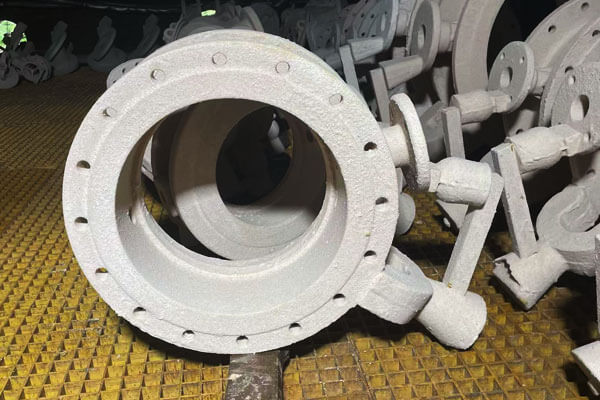
Dewaxing and shell baking
- Complete dewaxing avoids carbon residue and pinhole defects; shell sintering schedules remove organic binders and harden the ceramic.
- Virš- or under-baking affects shell strength and metal–shell reactions.
Tirpimas & melt treatment
- Lydykite švarą, Degazavimas, fluxing and inclusion control are critical—valve bodies are often pressure tested, and inclusions/pockets are liability points.
- For corrosion-sensitive alloys, vacuum melting or VIM/VAR processes may be required for Ni alloys or duplex stainless to control dissolved gases and inclusions.
Pilti & Šilumos valdymas
- Temperatūrai, pilimo greitis, and the use of bottom-pour tundishes vs. top pour approach affect turbulence and oxide entrapment.
- Directional solidification/feeding strategies (placement of gates and chills, use of feeders) reduce shrinkage porosity in critical sections.
Though investment casting has less provision for external feeders than sand casting, gating design and riser placement on the tree still enable feed paths.
Apvalkalo pašalinimas & valymas
- Controlled knock-out preserves thin sections and internal passage integrity; chemical cleaning must remove shell material without attacking metal.
6. Gaminamumo dizainas (DFM) — guidelines for investment-cast valve bodies
Investment casting enables complex shapes, but designers must respect process realities. Pagrindinės rekomendacijos:
Geometrija & sienos storis
- Maintain consistent wall thicknesses where possible. Sudden thickness transitions encourage shrinkage and hot spots.
Typical finished wall thickness range differs by material; consult caster’s capability, but target consistent sections and avoid very thin webs without reinforcement. - Use generous fillets and radii at intersections; sharp corners are stress concentrators and trap ceramic. Fillets ease mold fill and reduce defect sites.
Core design and internal passages
- Design internal passages with draft and taper where cores must be removed or to aid venting.
- Include core supports and vent channels to prevent core shifting during assembly and pour.
- Minimize internal re-entrant geometries that are difficult to core; prireikus, accept machining of critical internal seats.
Vartai, location and feeding
- Place gates to feed the thickest sections first and to promote directional solidification toward the sprue. Avoid gating directly into thin walls.
- Plan the gating system and part orientation on the tree to minimize post-machining of gates and risers.
Tolerancing & baigti
- Define gross dimensions achievable from casting and specify critical tolerances only where necessary.
Use finish-machined callouts (gręžiniai, sandarinimo veidai) and allow realistic machining stock. - Specify surface finish classes: as-cast external surfaces can be very good; internal surfaces from ceramic cores may be rougher and need finishing.
Medžiaga & process selection matched to function
- Select alloy families that match service (Pvz., duplex for chloride service). Consider manufacturability: some super-alloys require vacuum melting and more expensive ceramic systems.
7. Post-cast processing: terminis apdorojimas, apdirbimas, Apdaila ir surinkimas
Investment casting is usually followed by a sequence of steps to render valve bodies service-ready.
Terminis apdorojimas
- Streso palengvinimas: reduces casting stresses for dimensional stability.
- Sprendimo metinė + gesinimas / precipitation age: used for duplex and PH alloys to obtain required strength or phase balance.
- Stabilization anneal: sometimes required for certain stainless families to avoid sensitization.
Apdirbimas
- Kritinės grėsmės, sandarinimo veidai, threads and porting typically require finish apdirbimas.
Use stable fixturing and account for casting distortion post-heat treat. Plan machining allowances based on expected shrinkage and finish.
Paviršiaus apdaila
- Shot blasting or glass bead improves sealing surfaces and fatigue life; shot peening can improve fatigue but affects sealing faces, so selective masking/finishing is used.
- Pasyvavimas (for stainless steels), plating or coating (epoksidinė, fusion bonded epoxy) Apsaugai korozijai.
Welding and assembly
- If attachments are welded, ensure compatible filler metals and pre/post-weld heat treatments as required.
Weld locations should be designed to manage stresses and to avoid thin sections.
8. Tipiški defektai, root causes and countermeasures
Understanding frequent defect types avoids costly rework:
Susitraukimo poringumas / tuštumos
- Pagrindinės priežastys: inadequate feed, platus užšalimo diapazonas, hot spots.
- Atsakomosios priemonės: gate and tree design to feed thick zones, use of chills/insulating feeders on trees, alloy selection with narrower solidification ranges, optimized pour temperature and slower cooling where appropriate.
Dujų poringumas (vandenilis, entrained air)
- Pagrindinės priežastys: moisture in shell/core, hydrogen in melt, turbulent pouring.
- Atsakomosios priemonės: rigorous degassing, proper core drying, laminar pouring, vacuum pour or reduced superheat, and inclusion filtration.
Inclusions and slag
- Pagrindinės priežastys: poor melt handling, contaminated charge, inadequate fluxing.
- Atsakomosios priemonės: clean melt practice, nugriebimas, fluxing, use of ceramic filters, vacuum melting for reactive alloys.
Core movement and misruns
- Pagrindinės priežastys: poor core support, insufficient shell strength, improper assembly.
- Atsakomosios priemonės: robust core prints, support pins, optimized shell build, quality control at assembly.
Surface porosity and reactions (metal-shell reaction)
- Pagrindinės priežastys: high pour temperature, incompatible shell chemistry, reactive alloys (Pvz., Ti or reactive Ni alloys).
- Atsakomosios priemonės: adjust pour temp, change shell composition, apply barrier coatings (wash) to shell interior.
Hot tearing and cracking
- Pagrindinės priežastys: constrained solidification, high thermal gradients, wide freezing range alloys.
- Atsakomosios priemonės: design for shrinkage paths, rounding geometry, gate placement to avoid restraint across freezing ranges.
9. Tikrinimas, qualification and testing for valve bodies
Valve bodies are safety-critical and require layered inspection.
Matmenų tikrinimas
- Coordinate Measurement Machine (Cmm) checks of critical interfaces (varžtų skylės, flange diameters, bore positions), runout and flatness on sealing faces.
Neardomieji bandymai (Ndt)
- Radiografija / Rentgeno spindulys / CT nuskaitymas: identify internal porosity, intarpai, and core defects. CT enables complex internal passage inspection.
- Ultragarsinis bandymas (UT): good for volumetric defects in thicker sections.
- Dažai skvarbi: surface cracks, leaks at machined surfaces.
- Magnetic particle testing (for ferrous alloys): surface/near surface discontinuities.
- Positive Material Identification (PMI): verify alloy chemistry (critical for duplex & pagal Alloys).
Mechaninis bandymas
- Hardness and tensile tests (sample coupons or sacrificial castings) to confirm heat-treatment response and mechanical properties.
- Microstructure checks via metallography for phase balance (Pvz., duplex austenite/ferrite ratio).
Spaudimas & leak testing
- Hydrostatic and pneumatic pressure tests to proof against design pressure and to validate sealing surfaces. Helium or bubble leak testing for very small leaks.
10. Kaina, lead-time and production-volume tradeoffs vs. alternatives
Įrankiai & NRE
- Wax tooling and pattern costs are significant upfront; for low quantities (prototipai, mažos partijos) wax tooling can be justified if part complexity is high.
- For very low volumes, additive-manufactured patterns or 3D printed wax/resin patterns can reduce NRE.
Unit cost vs. apimtis
- Investment casting becomes cost-competitive as the number of parts increases compared with extensive machining from forgings or billet; break-even depends on complexity and required machining.
- Sand casting is less costly for very large parts or when surface/tolerance requirements are relaxed; die casting is attractive for non-ferrous high-volume thin-wall parts but limits alloy choices.
Pristatymo laikas
- Tool design, wax tooling and shell development add lead time. Parallel development of tooling and process trials shortens time-to-first-part, but expect weeks to months depending on complexity and the need for qualification.
11. Typical Applications of Custom Investment Cast Valve Bodies
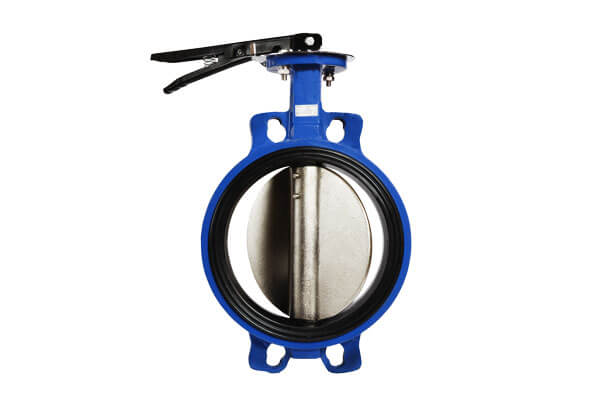
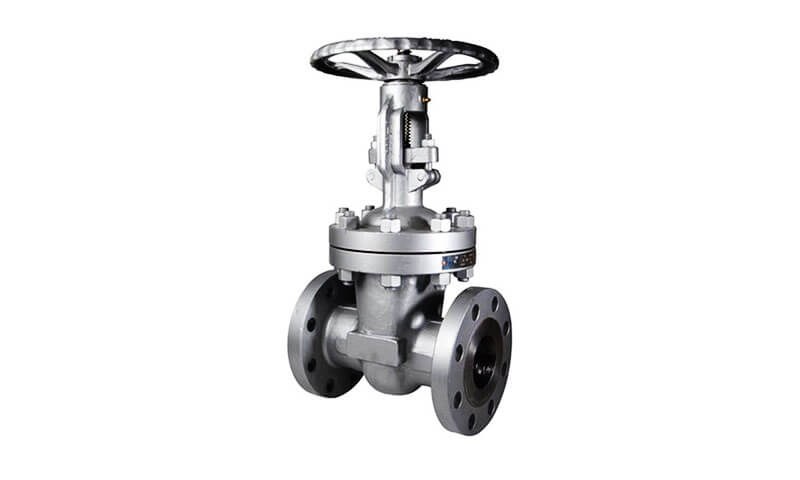
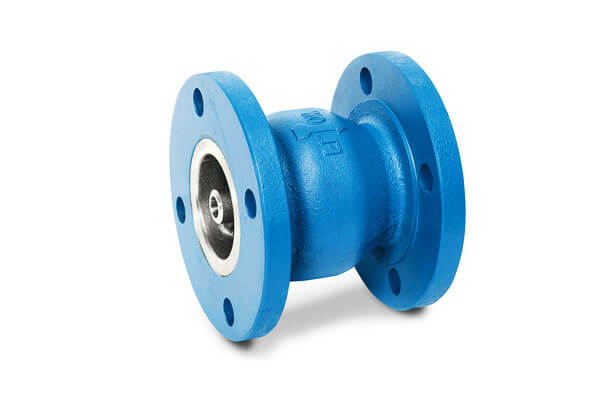
- Aliejus & Dujos: Rutuliniai vožtuvai, vartų vožtuvai, Patikrinkite vožtuvus, Dispecoko vožtuvai
- Naftos chemija & Cheminė: Corrosion‑resistant stainless steel and nickel‑alloy valves
- Elektrinės: High‑temperature and high‑pressure boiler and steam valves
- Jūrų & Jūroje: Duplex stainless steel and anti‑corrosion valves
- Vandens valymas & Gėlinimas: 304 / 316 stainless steel valves
- Special Fluid Systems: Custom‑designed non‑standard valves
12. Comparative analysis — Investment casting vs. other processes
| Evaluation criteria | Investicijų liejimas | Smėlio liejimas (žalias / shell) | Kalimas + apdirbimas |
| Design complexity & geometry freedom | Excellent – supports highly complex external shapes, Plonos sienos, re-entrant features, and integrated bosses | Moderate – suitable for simple to moderately complex geometries; thin walls and fine features are limited | Low – geometry constrained by forging die design; complex shapes require extensive machining |
| Internal passage capability | Excellent – ceramic cores enable complex, multi-port internal flow paths | Moderate – sand cores allow large passages, but accuracy and complexity are limited | Poor – internal passages must be drilled, milled, or assembled from multiple components |
| As-cast dimensional accuracy | High – tight tolerances achievable, minimalus apdirbimas | Low to moderate – wide tolerances, significant machining required | Netaikoma (dimensions achieved by machining) |
Paviršiaus apdaila (AS-CAST) |
Very good – smooth ceramic shell surface | Poor to fair – rough surface, often requires heavy machining | Excellent on machined surfaces |
| Medžiaga / lydinio lankstumas | Very wide – stainless steels, Duplex, PH pažymiai, Ni pagrįsti lydiniai, vario lydiniai | Wide – ferrous and non-ferrous alloys; metallurgical control less refined | Very wide – wrought-quality steels, stainless and specialty alloys |
| Mechaninės savybės (tipiškas) | Good to excellent – depends on alloy and heat treatment; suitable for pressure service | Moderate – coarser grain structure; properties vary more widely | Excellent – superior strength, toughness and fatigue resistance due to forged grain flow |
| Pressure integrity & leak resistance | High – good control of porosity with proper gating and melt practice | Moderate – higher risk of shrinkage porosity and leakage paths | Very high – dense material with minimal internal defects |
Machining requirements |
Low – near-net shape; machining focused on sealing faces and bores | High – extensive machining required to meet tolerances and surface requirements | Very high – most features are machined |
| Gamybos apimties tinkamumas | Žemo ir vidutinio tūrio; complexity-driven economics | Low volumes and very large parts | Low to medium volumes where performance justifies cost |
| Įrankių kaina (NRE) | Moderate to high – wax and core tooling | Low – relatively simple patterns | High – forging dies plus machining fixtures |
| Švino laikas | Moderate – tooling and process setup required | Short – fast pattern production | Moderate – tooling plus machining programming |
Typical risks & apribojimai |
Core shift, shell cracking, internal porosity if process control is poor | Dimensional variability, paviršiaus defektai, didesnis poringumas | Aukštos medžiagos atliekos, high machining cost, limited internal geometry |
| Best-fit valve body applications | Complex valve bodies requiring corrosion resistance, griežtos tolerancijos, and integrated internal passages | Didelis, low-cost valve bodies with simple flow paths and generous tolerances | Aukšto slėgio, fatigue-critical valve bodies where geometry is simple and maximum mechanical performance is required |
13. Išvada
Investment casting is a best-fit technology when valve body designs demand internal complexity, tight finish tolerances, ir lydinio lankstumas.
The path to a reliable, serviceable valve body starts with a clear matrix of service requirements (spaudimas, temperatūra, skystis), selection of an appropriate alloy family, and early collaboration with investment casting specialists to marry design to process.
Control of melt quality, ceramic core integrity, gating and shell parameters, and an inspection regime that matches service criticality are the pillars of success.
When these variables are managed together, investment casting yields valve bodies that offer optimized performance, reduced secondary operations, and excellent lifecycle value.
From Design to Reliability: LangHe Custom Cast Valve Body Solutions
Nuo LangHe Custom Cast Valve Body, customers gain access to a fully engineered casting solution rather than a simple manufactured part.
Langhe focuses on translating valve performance requirements—pressure rating, internal flow geometry, atsparumas korozijai, and dimensional accuracy—into optimized casting designs that balance metallurgical integrity with manufacturability.
By combining design-for-manufacturing expertise, controlled casting processes, and rigorous inspection practices, Langhe delivers custom valve bodies that reduce machining, improve sealing reliability, and support long-term service performance across demanding industrial applications.