介绍
Viscosity represents one of the most critical rheological parameters governing the behavior of ceramic shell slurries in 投资铸造. It directly influences slurry flow characteristics, 涂层均匀性, and structural integrity of the shell system.
最后, precise viscosity measurement and control serve as a foundational element in achieving high-performance castings—particularly in industries such as aerospace, 汽车, 和精密工程,
where dimensional tolerances often fall within ±0.01 mm and surface roughness requirements can be below Ra 2 μm.
Building on both rheological theory and industrial best practices, this paper provides a systematic and in-depth analysis of slurry viscosity.
It covers its physical interpretation, its role throughout shell fabrication, process control significance, influencing variables, and standardized measurement approaches.
此外, supported by empirical data and engineering insights, this study highlights viscosity as a key “data-driven control parameter” in modern intelligent manufacturing systems.
1. Fundamental Understanding of Slurry Viscosity
From a fluid mechanics perspective, viscosity is defined as the internal resistance of a fluid to shear deformation,
mathematically expressed as the ratio of shear stress (τ) to shear rate (γ̇), typically measured in Pa·s or mPa·s.
然而, in ceramic shell systems, viscosity is far from a fixed property—it is a dynamic indicator of the slurry’s internal structure.
Unlike Newtonian fluids, ceramic slurries—especially those with high solid loading (commonly 55–65 vol%)—exhibit pronounced non-Newtonian behavior.
Most notably, they demonstrate shear-thinning characteristics, where viscosity decreases significantly as shear rate increases.
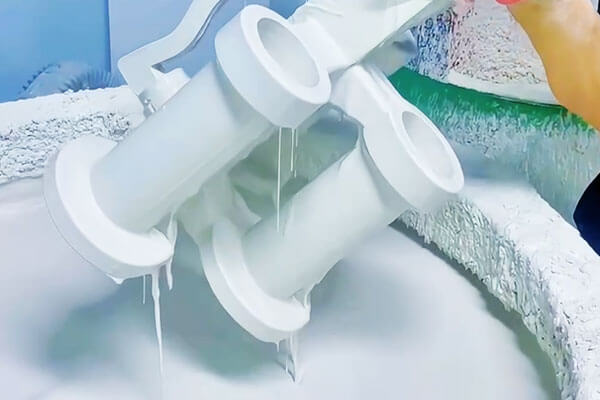
例如, viscosity may drop by 40–70% when shear rate increases from 1 s⁻¹ to 100 s⁻¹, enabling both storage stability and process adaptability.
Equally important is thixotropy, a time-dependent behavior where viscosity decreases under continuous shear and gradually recovers once the shear is removed.
This reversible structural transformation is essential: during coating, reduced viscosity ensures smooth flow and coverage; after deposition, viscosity recovery helps maintain layer integrity and prevents sagging.
At a microstructural level, viscosity reflects complex particle–particle and particle–binder interactions, including van der Waals forces, electrostatic repulsion, steric hindrance, and polymer chain entanglement.
These interactions form a transient three-dimensional network, which breaks down under shear and rebuilds upon rest.
所以, viscosity measurement effectively serves as a macroscopic probe of microscopic structural stability.
实际上, an optimized slurry should exhibit:
- High viscosity at low shear rates (0.1–10 s⁻¹) to prevent sedimentation
- Rapid viscosity reduction at moderate shear rates (10–100 s⁻¹) for good coatability
- Fast structural recovery after shear cessation to ensure coating stability
2. Critical Influence of Viscosity on Ceramic Shell Quality: From Coating to Sintering
The overall performance of ceramic shells in investment casting is the cumulative result of multiple interrelated stages, including slurry preparation, 涂层, 烘干, 射击, 和金属浇注.
Within this integrated process, slurry viscosity functions as a fundamental control parameter, exerting a continuous and decisive influence on shell quality from initial coating to final sintering.
Impact on Coating and Film Formation
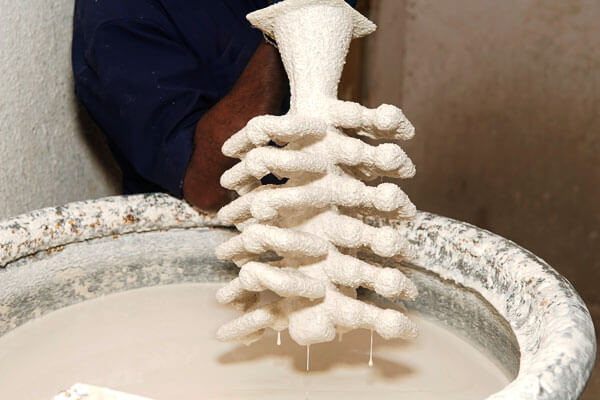
To begin with, during the coating and film formation stage, viscosity plays a determining role in both coatability and layer uniformity.
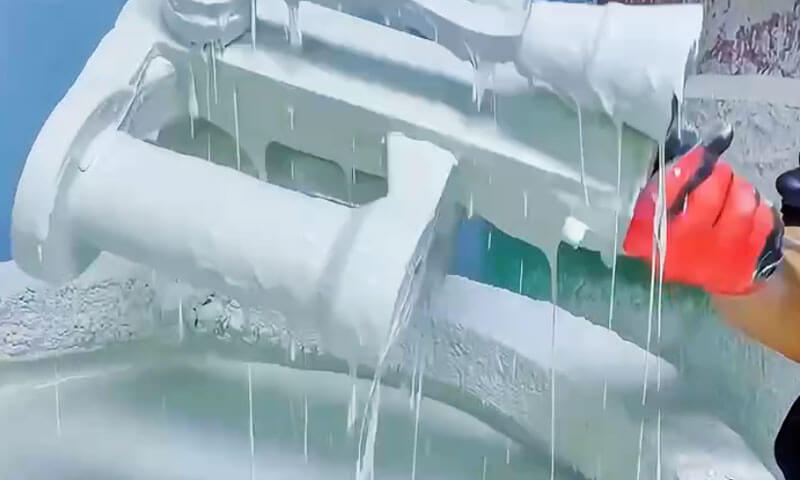
When viscosity is too low, the slurry exhibits excessive fluidity, leading to runoff, dripping, and insufficient film build-up on the wax pattern.
This often results in non-uniform coatings, increased surface roughness, and defects such as sand adhesion on the final casting.
另一方面, excessively high viscosity restricts flowability, preventing the slurry from adequately covering intricate geometries—particularly in thin-walled sections and deep cavities,
thereby causing local defects such as voids or incomplete coverage, which compromise shell integrity.
Influence on Drying and Strength Development
Industrial practice demonstrates that maintaining a controlled viscosity range is essential.
例如, in precision blade manufacturing, a surface slurry viscosity of approximately 25 秒 (Zahn cup #4) has been shown to achieve an optimal coating weight of around 4 g per layer and a surface finish near Ra 2 μm, significantly reducing defect incidence.
而且, consistent viscosity is critical for maintaining uniform coating thickness; fluctuations can lead to uneven shell strength distribution, increasing the risk of downstream failure.
Influence on Drying and Strength Development
随后, during the drying and strength development phase, viscosity strongly influences both particle packing density and crack susceptibility.
Slurries with moderately higher viscosity tend to dry more slowly, allowing sufficient time for particle rearrangement and densification, which enhances both green strength and high-temperature strength after firing.
然而, if viscosity becomes excessively high, internal stresses generated during drying shrinkage may exceed the tolerance of the binder network.
This can result in microcracking within the shell structure, which may propagate during firing or pouring, ultimately causing shell delamination or collapse.
To address this issue, process optimization often includes the incorporation of polymer modifiers or flexibilizing agents.
These additives improve the film-forming capability of the binder system, reduce internal stress concentration, and effectively suppress cracking and deformation during drying.
Effect on Roasting, 渗透性, and Thermal Performance
此外, in the firing stage and subsequent permeability development, viscosity indirectly governs pore structure and thermal transport behavior.
具体来说, viscosity influences coating density, which determines the distribution and connectivity of pores within the shell.
A well-controlled viscosity produces a uniform microporous network, facilitating efficient gas evacuation during pouring and minimizing defects such as porosity and pinholes.
然而, an imbalance in viscosity can disrupt this relationship.
Excessively high viscosity leads to overly dense coatings with reduced permeability, hindering mold filling and increasing the likelihood of misruns or cold shuts.
反过来, overly low viscosity results in loose, porous structures with insufficient mechanical strength, making the shell vulnerable to erosion or failure under molten metal impact.
所以, viscosity control is essential for achieving an optimal balance between mechanical strength and gas permeability—two inherently competing requirements.
Impact on Pouring and Casting Quality
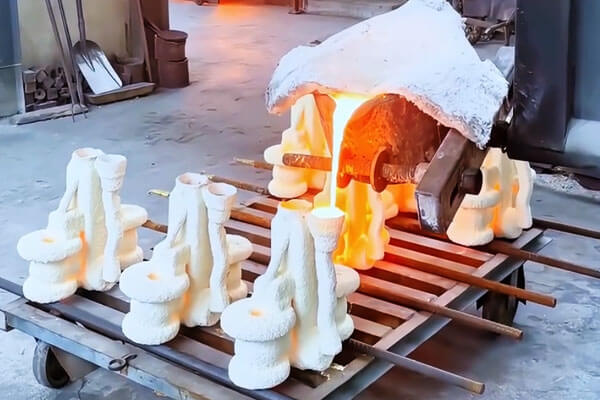
最后, during metal pouring and solidification, the thermal performance of the ceramic shell—closely linked to its microstructure—is also influenced by slurry viscosity.
Shells formed from well-controlled viscosity systems tend to exhibit uniform bonding and higher density, resulting in improved thermal conductivity.
This promotes more uniform heat transfer, accelerates solidification rates, and contributes to refined grain structures and enhanced mechanical properties of the casting.
相比之下, poorly controlled viscosity can lead to heterogeneous structures with uneven thermal behavior, increasing susceptibility to thermal stress concentration, 外壳开裂, and even catastrophic failures such as metal leakage.
概括
综上所述, viscosity should not be regarded as an isolated processing parameter but rather as a central coordinating factor—effectively a “control hub”—that links all stages of ceramic shell fabrication.
Precise and stable viscosity control is essential to achieving a well-balanced combination of properties, including adequate green strength, 高温稳定性, controlled residual strength, 化学惰性, and optimized permeability and thermal conductivity.
3. Purpose of Viscosity Measurement and Its Role in Process Control
在熔模铸造中, viscosity measurement is far more than obtaining a single numerical value. It serves as a pivotal input for closed-loop process control and quality assurance systems.
By transforming traditional, experience-based trial-and-error approaches into data-driven, 可重复的, and predictable workflows, viscosity measurement enables scientific manufacturing and consistent product quality.
Viscosity as a Basis for Formulation Optimization
Viscosity provides a quantitative foundation for optimizing slurry formulations.
During the research and development stage, systematic adjustments to variables such as powder-to-liquid ratio, binder concentration, dispersant type and content, and particle size distribution are paired with precise viscosity measurements.
This approach allows engineers to establish reliable “formulation–viscosity–performance” correlations.
例如:
- Increasing the alumina powder volume fraction by 5% typically raises slurry viscosity by 1500–2000 mPa·s.
- Employing a bimodal particle distribution (coarse:fine = 7:3) can reduce viscosity by 25–30% compared to a single particle size system, while maintaining optimal sintering density.
- A target solid loading of 58 vol% with viscosity around 3200 mPa·s often provides the best balance of high solid content and manageable fluidity, maximizing shell density and strength.
相似地, binder optimization is guided by viscosity data: insufficient binder results in weak green strength, whereas excessive binder increases viscosity sharply and slows drying.
Controlled experimentation can identify optimal binder ranges (例如。, 1.0–1.5 重量%), ensuring consistent shell formation.
Viscosity as a Tool for Standardization and Process Control
On the production floor, viscosity functions as the 第一道防线 for batch consistency.
By standardizing measurement conditions—such as maintaining temperature at 25°C ±1°C and shear rate at 10 s⁻¹—and enforcing strict control limits (例如。, 2000–8000 mPa·s),
deviations caused by raw material variability, 环境条件, or slurry aging can be quickly detected.
Temperature sensitivity illustrates this principle: a 5°C increase can lower viscosity by 8–12%, highlighting the importance of maintaining a controlled environment (23–27°C) to ensure stable operation.
When viscosity readings fall outside predefined limits, root causes—such as damp powder, degraded binder, or insufficient dispersant—can be identified and corrected immediately.
Industrial data demonstrates the impact of rigorous viscosity control: by implementing standardized monitoring,
one production team reduced the scrap rate of a batch from 30% to under 5%, dramatically improving first-pass yield and operational efficiency.
Viscosity as a Foundation for Intelligent Manufacturing
With the rise of automated and intelligent investment casting processes—including robotic coating, automated pattern handling, and digital twin simulations—real-time viscosity measurement has become indispensable.
Automated coating systems, 例如, rely on live viscosity data to dynamically adjust parameters such as coating speed, nozzle pressure, and slurry supply, ensuring uniform layer thickness across complex geometries.
Integration of online viscometers in slurry tanks or circulation pipelines enables continuous monitoring, 形成 closed-loop feedback system that supports adaptive control and predictive maintenance.
In this way, viscosity measurement transitions from a laboratory procedure into a “digital link” connecting raw materials, 过程参数, 设备性能, and final product quality.
概括
Viscosity measurement in investment casting is no longer a simple laboratory test; it is a core technical link enabling data-driven, predictive, and reproducible manufacturing.
By providing actionable insights for formulation optimization, process standardization, and intelligent automation, it ensures slurry consistency, enhances shell quality, and maximizes casting reliability.
最终, precise viscosity control is essential for transforming investment casting from an experience-dependent craft into a high-precision, 现代的, and fully controlled manufacturing discipline.
4. Key Influencing Factors of Slurry Viscosity and Control Standards
The viscosity of ceramic shell slurries is affected by multiple factors, including internal factors such as powder properties and formula composition, and external factors such as ambient temperature and aging time.
The following is a detailed analysis of the key influencing factors, their influence rules, and corresponding control goals and typical values (for reference only):
| Influencing Factor | Influence Rule on Viscosity (例子) | Influence on Shell Performance | Control Goals and Typical Values (Reference Only) |
| 粉液比 | For every 5% increase in powder volume fraction, the viscosity increases by about 1500-2000 mPa·s; the viscosity rises sharply when the volume fraction exceeds 65% |
High solid content improves shell density and strength, but excessively high content leads to coating difficulties and cracking | Optimized to 58 体积%, viscosity stabilizes at 3200 mPa·s, sedimentation rate <4% |
Powder Particle Size Distribution |
Using a binary gradation of “coarse powder + fine powder” (例如。, 7:3) can reduce viscosity by 25%-30% | Gradation optimization improves fluidity, ensures sintering density, and reduces pores | Electrically fused mullite powders of 220#, 320#, 和 1000# are mixed in a ratio of 20%:65%:10%, with a viscosity of about 25 秒 (Zahn-4 cup) |
| 活页夹 (二氧化硅溶胶) 专注 | Viscosity increases with the increase of concentration; but the impact on strength is relatively small | Affects the gelation speed and high-temperature strength of the shell; excessive addition may increase brittleness | The impact of silica sol on shell strength needs to be optimized in combination with other factors |
Dispersant Type and Content |
Incorrect selection or insufficient addition (<1%) leads to agglomeration and doubled viscosity; excessive addition (>3%) affects curing | Effectively disperses powder, 降低粘度, improves stability, and prevents sedimentation | Phosphate-based dispersants are preferred for alumina powder, with an optimal addition amount of 1%-3% |
| Ambient Temperature | For every 5℃ increase in temperature, the viscosity decreases by 8%-12% | Temperature fluctuations lead to unstable viscosity, affecting coating consistency | The printing/coating environment needs to be stabilized at 23-27℃, with a fluctuation ≤±1℃ |
老化时间 |
As standing time increases, thixotropy enhances, and viscosity increases slowly over time | Affects the coating reproducibility of the slurry; viscosity should be measured after standard aging time | A standard aging time (例如。, 24h) should be established before viscosity measurement |
| Viscosity Control Range | - | Directly determines coatability, 统一, 力量, and air permeability | Viscosity control range of ceramic slurry: 2000-8000 mPa·s (25℃) |
It should be emphasized that the above typical values are for reference only.
实际生产中, the optimal viscosity control range and parameter settings should be determined according to the specific slurry formula, powder type, casting structure,
and process requirements, and verified through a large number of experiments and production practices.
5. 结论
总之, viscosity is not merely a measurable property but a central parameter linking material formulation, 过程控制, and final product performance in investment casting.
Its non-Newtonian and thixotropic nature enables a delicate balance between stability and workability, while its precise control determines key shell characteristics such as strength, 渗透性, and thermal behavior.
而且, as manufacturing continues to evolve toward digitalization and automation, viscosity measurement is becoming an essential component of intelligent process control.
Establishing standardized measurement protocols, understanding influencing factors, and defining application-specific control ranges are critical steps toward achieving consistent, high-quality production.
展望未来, with the integration of real-time monitoring and data analytics, viscosity will play an increasingly strategic role in advancing precision casting toward higher efficiency, lower defect rates, and fully optimized manufacturing systems.